

Explore some of the best crypto affiliate networks and programs in one place. Use the list below to compare available partners and find an option that fits your audience, target markets, and campaign goals.
| # | Partner | Type | Since | Offer scope | GEOs | Payment models | Registration | More |
|---|---|---|---|---|---|---|---|---|
| 1 |
 Affiliate Top
|
Direct advertiser |
n/a |
1 |
Any |
RevShare Turnover Share |
No approval required |
|
| 2 |
 TrumpYourAds
|
Network |
2020 |
1,000+ |
Any |
CPA |
Approval required |
|
| 3 |
 CIPIAI
|
Network |
2024 |
50+ |
Tier-1 Tier-2 |
CPI CPL CPA RevShare CPT FTD SOI |
No approval required |
Crypto Affiliate Networks vs. Direct Affiliate Programs
A crypto affiliate network brings offers from multiple advertisers together on one platform. Instead of opening a separate account with every company, you can compare GEOs, funnels, and commission models such as CPA, CPL, RevShare, and Hybrid from a single dashboard. If an offer reaches its cap or its conversion rate drops, it is usually easier to test an alternative without rebuilding the entire setup.
The downside is that the network acts as an intermediary. There may be less room to negotiate individual rates, limited visibility into the advertiser’s decisions, and slower feedback on rejected conversions. Available GEOs, caps, and payout terms can also change when the advertiser updates the campaign.
A direct affiliate program is operated by the advertiser itself. Direct communication often makes it easier to discuss custom rates, higher caps, payment schedules, creatives, and landing pages once an offer starts producing stable results. It can also provide clearer feedback on traffic quality and conversion approval.
However, a direct program ties the setup to one product or brand. If the offer is paused, a GEO closes, or the funnel stops converting, there may be no immediate replacement.
Networks are more practical when testing several offers and GEOs. Going direct makes more sense when a campaign has proven its value and there is enough volume to negotiate better terms. The AffDays listing lets you compare both partner types by offer scope, GEO coverage, payment model, and approval requirements.
How to Choose a Crypto Affiliate Network
The highest CPA on the offer card does not guarantee the best return. What matters is the approved revenue and actual ROI after the first test: conversion rate, approval rate, scrub, hold period, and EPC. A lower payout with stable approval can outperform a premium rate surrounded by unclear qualification rules.
Offers, GEOs, and Caps
The offer pool should match the GEOs you actually work with. Check whether campaigns are direct, exclusive, or brokered, since this can affect feedback speed and flexibility around rates and limits.
A payable conversion may require registration, completed KYC, a first-time deposit, a minimum deposit amount, or a specific trading volume. Confirm these conditions before testing, along with the available landing pages and whether custom pre-landers or creatives are allowed.
Check both test and daily caps before launch, including whether the limits can be raised after stable approved results.
Payouts and Approval Rates
Review the minimum payout, payment schedule, hold period, possible deductions, and rate-bump conditions. A higher headline commission is less useful when validation is unpredictable or payments are delayed.
The network should provide conversion statuses, clear rejection reasons, and a process for reviewing disputed leads. Compare partners by approved revenue and payment reliability, not the advertised payout alone.
Tracking and Conversion Data
Useful reporting should support Sub-IDs, postback or S2S tracking, conversion statuses, and clear rejection reasons. Before launch, confirm which funnel events are available and how the network investigates missing conversions or tracking discrepancies.
Traffic Rules and Account Support
Every offer has its own restrictions on brand bidding, paid social, push, native, email, and custom creatives. These rules should be reviewed before launch, since a traffic source or promotional angle accepted by one advertiser may be rejected by another.
Before committing volume, ask the manager for current caps, qualification details, expected approval timing, and fallback offers for the same GEO. Use the AffDays listing to build a shortlist, then confirm live rates and campaign conditions directly with each crypto affiliate network.
Rules for incentive crypto traffic are especially offer-specific, so get written confirmation from the manager before using this approach.
How We Evaluate Crypto Affiliate Networks
The AffDays listing is designed as a first filter for comparing crypto affiliate networks and direct advertisers before opening accounts and testing offers. We compare each entry using the information available at the time of review, focusing on the details displayed in the table.
Partner Type shows whether the company operates as a network or a direct advertiser. Since provides context about its time in the market, while Offer Scope indicates how many campaigns may be available through the platform. GEOs help determine whether a partner is relevant to a particular market. Payment Models show whether it supports CPA, CPL, RevShare, FTD, or other arrangements. We also note whether registration requires manual approval.
These fields help narrow the options, but they do not predict campaign performance on their own. A large offer pool has limited value if the relevant GEOs, conversion requirements, or payment model do not match the setup.
The listing is an editorial overview based on the information available at the time of review, not a guarantee of conversion or payment performance. Rates, caps, qualification rules, and traffic restrictions can change, so confirm the current conditions directly with the partner before launch.
How to Promote Crypto Affiliate Offers
A workable promotion strategy starts with the payable event, not the advertised payout. The traffic source, funnel, and optimization rules should reflect what the user must actually complete—registration, KYC, a first-time deposit, or a minimum trading volume.
Match the Source to the Payable Action
Search and SEO traffic often fit exchanges, wallets, tax software, and trading tools that solve a clear user problem. Native and push placements depend more heavily on the angle and pre-lander, while YouTube, Telegram, email, and established communities can deliver users who need less explanation before converting.
The source must match the depth of the funnel. Generating a registration is different from finding users prepared to submit documents, pass KYC, and fund an account. A cheap click has little value when the payable action sits several steps further down the flow.
X can also work for crypto campaigns built around news, personalities, and community-led angles. Our guide to promoting crypto offers on X covers the platform-specific setup in more detail.
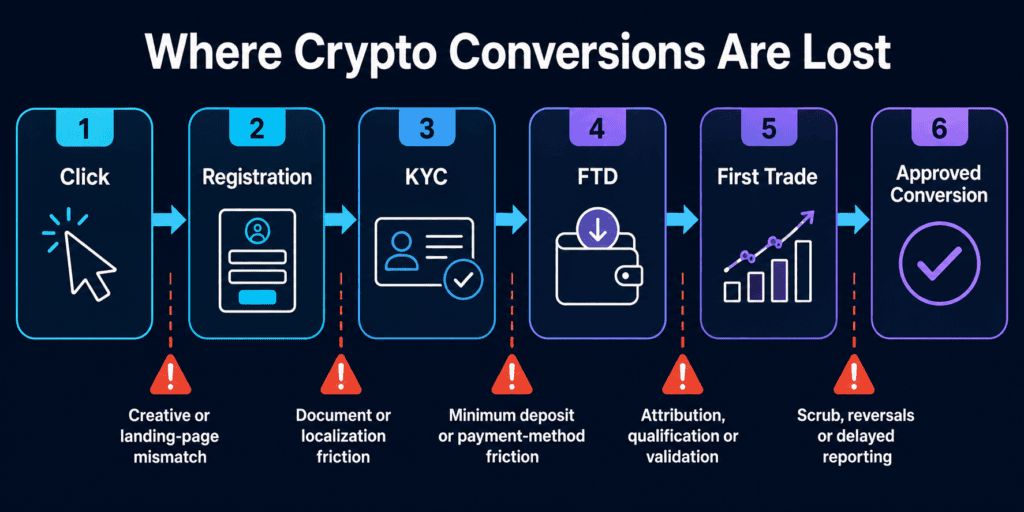
Diagnose the Funnel Event by Event
Track registration, KYC, FTD, first trade, and approval as separate events through postback/S2S tracking. A single final conversion does not show where users are dropping out or which part of the setup needs work.
Front-end and back-end problems require different fixes. If click-to-registration falls, review the creative, angle, pre-lander, and landing-page match. If registrations remain stable but KYC-to-FTD declines, the issue may be document requirements, minimum deposit, payment methods, GEO restrictions, or friction inside the advertiser’s product. Changing the creative will not solve a weak back end.
Sub-IDs should separate GEOs, placements, devices, creatives, and landing pages. This allows performance to be compared by approved conversions rather than blended registration totals.
Set Cut and Scale Rules Around Approved Results
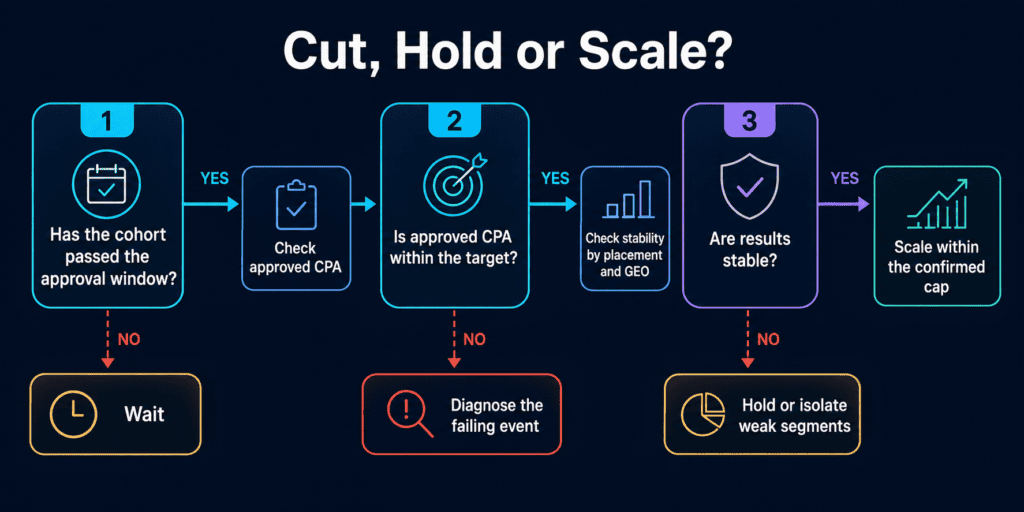
A fixed click limit is a poor universal cut rule. The amount of data required depends on expected conversion rate, payout, approval rate, and the maximum acceptable cost per approved conversion. A high-payout FTD offer can justify a larger test than a low-paying registration flow.
Delayed approval also affects decision-making. Front-end ROI may look positive before scrub and reversals are applied. Compare mature cohorts—traffic that has passed the full validation window—instead of relying only on today’s dashboard totals.
Scale when approved EPC and cost per approved conversion remain stable across enough data, not when the tracker reports the first few registrations.
Prepare Caps, Rate Bumps, and Fallback Offers
Before increasing volume, confirm the available cap, payout terms, and conditions for a rate bump. Scaling into a low daily cap wastes usable traffic and forces unnecessary changes to a working setup.
A fallback offer should match more than the GEO. It should have a similar payable event, KYC friction, minimum deposit, payment flow, and user journey. Otherwise, traffic cannot be redirected without adapting the creative and pre-lander. Keep these alternatives ready before the primary offer reaches its limit, pauses, or changes qualification rules.
FAQ
Confirm the accepted GEOs and traffic sources, payable conversion event, KYC requirements, minimum deposit or trading volume, current rate, available cap, hold period, and payment schedule. Tracking should also be configured before launch, including Sub-IDs and postback/S2S events for registration, KYC, FTD, and approval where available.
A tracker may assign expected revenue before the advertiser completes validation. Failed KYC, duplicate users, deposits below the required amount, attribution issues, scrub, and reversals can reduce the final number of payable conversions. Evaluate mature cohorts that have passed the full approval window instead of relying on today’s estimated ROI.
A recorded FTD means the tracker received a first-time deposit event. It does not automatically mean the conversion is payable. The advertiser may still verify the user’s identity, GEO, deposit amount, payment method, attribution, account history, and any required trading activity. An approved FTD is one that has passed these checks and qualifies for commission under the offer terms.
First compare time zones, click IDs, Sub-IDs, event names, attribution windows, and postback timestamps. Differences may also come from delayed reporting, duplicate filtering, redirects that remove tracking parameters, or one platform counting registrations while the other reports only approved events. Use postback logs and individual conversion records to locate the missing stage before increasing volume.
Request a rate review after the campaign produces consistent approved volume and stays within the advertiser’s quality requirements. Bring data on approved conversions, EPC, rejection rate, and the volume you can deliver at a higher cap. A higher payout is useful only if the approval rules and payment terms remain unchanged.
Matching the GEO is not enough. The replacement should have a similar payable event, KYC process, minimum deposit, payment flow, product type, and user journey. If these elements differ, treat it as a separate campaign and retest the creative and pre-lander.
Only when the language, product access, deposit methods, KYC process, qualification rules, and landing-page claims remain relevant in each market. Even similar GEOs can produce different registration-to-FTD and approval rates. Track countries separately and localize the funnel before combining results or increasing volume.

Ratmir started his copywriting career back in 2016. He is now editor-in-chief with an MA with Honors in Linguistics.
His primary expertise is in affiliate marketing, EdTech, education, IT, and sports.
Ratmir specializes in content marketing, content management, proofreading, and translation.