

Sweepstakes affiliate networks connect affiliates with offers based on prize draws, giveaways, and similar promotions. They are popular because these offers are easy for users to understand and can work across a wide range of GEOs and traffic sources. Below, we’ve selected sweepstakes affiliate networks and programs worth considering in 2026.
| # | Partner | Since | Offer scope | GEOs | Payment models | Registration | More |
|---|---|---|---|---|---|---|---|
| 1 |
 ClickDealer
|
2012 |
18,000+ |
180 |
CPA RevShare Hybrid |
Approval required |
|
| 2 |
 MyLead
|
2014 |
5,500+ |
Any |
CPA CPL COD SOI CPS RevShare PPI |
No approval required |
|
| 3 |
 CpaRoll
|
2021 |
400+ |
80+ |
CPA RevShare |
Approval required |
How We Ranked the Best Sweepstakes Affiliate Networks
We compared sweepstakes affiliate networks based on several practical factors:
- Offer selection and GEO coverage: The range of active sweepstakes offers and supported markets.
- Traffic compatibility: Which traffic sources and promotional methods are accepted.
- Payouts and payments: Commission rates, payment frequency, holds, and payout reliability.
- Tracking and support: Reporting tools, postbacks, affiliate managers, and overall network reputation.
We gave the most weight to offer availability, traffic compatibility, and reliable payments rather than advertised payouts alone.
How to Choose a Sweepstakes Affiliate Network
Check the available GEOs. Make sure the network has active offers for your target country and audience rather than relying on “global coverage” claims.
Match the network to your traffic source. Confirm that your exact source—push, pop, native, social, email, or search—is accepted.
Compare payouts and payment terms. Consider holds, caps, validation rules, payment frequency, and minimum withdrawal alongside the advertised payout.
Check traffic and creative restrictions. Review the rules for incentivized traffic, pre-landers, brand assets, and aggressive creatives before launch.
Evaluate tracking and support. Look for reliable reporting, postbacks, sub-ID tracking, and an affiliate manager who can quickly resolve campaign issues.
How Sweepstakes Affiliate Networks Work
A sweepstakes affiliate network connects affiliates with advertisers running prize draws, giveaways, and similar offers. The network provides access to campaigns, tracking, payments, and affiliate support.
Each offer comes with its own GEOs, payout, conversion flow, traffic rules, caps, validation requirements, and creative restrictions. Networks may also provide creatives, landing pages, pre-landers, or localized funnels. Conversions are validated before payment and can be rejected for duplicate or fraudulent leads, prohibited traffic, or other advertiser requirements.
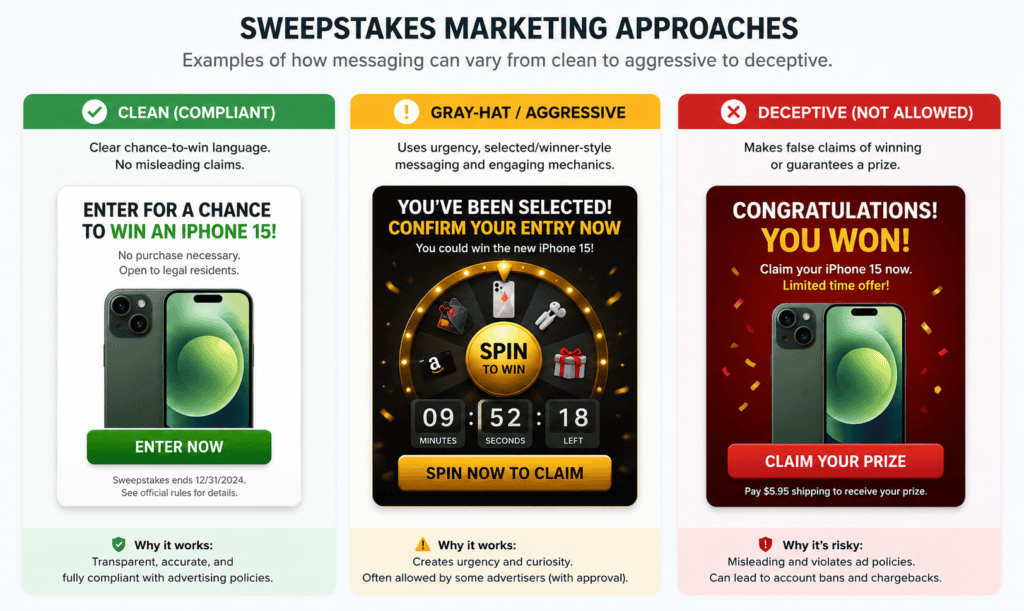
Clean vs Gray-Hat Sweepstakes Affiliate Marketing
A clean sweepstakes campaign clearly states that the user is entering for a chance to win and explains the required action. Gray-hat campaigns use more aggressive but technically qualified messaging, such as suggesting that a user has been selected or shortlisted, adding countdown timers and spin-to-win mechanics, or featuring recognizable prizes without explicitly claiming brand sponsorship.
A campaign moves beyond the gray area into deceptive advertising when it falsely states that the user has already won, fabricates reviews or winner notifications, impersonates a brand, hides billing or subscription conditions, or presents materially different claims across the advertisement, pre-lander, and final offer.
Rules for aggressive sweepstakes creatives vary between networks and advertisers. Some permit strong but accurate messaging on push, pop, or native traffic, while others require clean creatives and explicit disclosures. Brand assets, pre-selected winner language, pre-landers, CC Submit funnels, and mobile subscription flows may require approval before launch.
Network approval does not guarantee compliance with the traffic source. An angle accepted by an affiliate manager may still be rejected by Google, Meta, TikTok, or another advertising platform. Cloaking, false prize claims, hidden billing terms, or different content shown to moderators and users can result in ad rejection, account suspension, scrubbed leads, withheld commissions, or termination from the affiliate network. A sustainable aggressive angle creates urgency without misrepresenting the prize, the user’s status, or the cost of participation.
Affiliate Network vs Direct Sweepstakes Program
| Factor | Affiliate network | Direct program |
|---|---|---|
| Offer selection | Campaigns from multiple advertisers | Campaigns from one advertiser or brand |
| GEO coverage | Usually broader | Limited to the advertiser’s markets |
| Testing | Easier to rotate offers and funnels | Fewer alternatives |
| Commercial terms | Negotiated through the network or affiliate manager | Negotiated directly with the advertiser |
| Tracking and payments | Centralized in one platform | Managed directly by the advertiser |
Sweepstakes affiliate networks are generally better for testing, diversification, and international traffic. Direct programs can be more attractive when an affiliate already has proven volume for a particular offer, audience, or GEO.
Sweepstakes Offers vs Sweepstakes Casinos
| Factor | Traditional sweepstakes offers | Sweepstakes casinos |
|---|---|---|
| Primary objective | Lead generation or subscription acquisition | Player acquisition and monetization |
| User action | Submit details, confirm registration, enter a PIN, or activate a trial | Register, make a qualifying purchase, or become an active player |
| Common commission models | SOI, DOI, CPL, CPA, CC Submit | CPA, revenue share, or hybrid |
| Key evaluation criteria | Flow, GEO, validation rules, traffic sources, and payout | Player value, conversion rate, retention, commission terms, and regulation |
The key difference is that traditional sweepstakes offers usually pay for a lead or subscription, while sweepstakes casinos monetize users through gaming activity.
Types of Sweepstakes Affiliate Offers
SOI (Single Opt-In) is primarily a volume play. The conversion fires after one form submission, so the low-friction flow works well with push, pop, native, and permitted social traffic. However, a strong raw CR can be misleading: duplicate registrations, bots, fake data, and prohibited incentivized traffic may be scrubbed during validation. The metric that matters is approved EPC, not the number of form submissions shown in the tracker.
Usually, this type of offers has the lowest friction because the user only needs to submit basic information. Our SOI voucher campaign case study shows how this type of flow was tested and scaled across several European GEOs.
DOI (Double Opt-In) adds an email or SMS confirmation step. That second action cuts part of the funnel, but it also filters out low-intent and invalid leads. A higher payout will not offset a weak confirmation rate, so affiliates should optimize for confirmed conversions rather than initial submits.
CC Submit is the highest-friction and most compliance-sensitive sweepstakes flow. The headline payout is higher, but campaign economics depend on card acceptance, billing GEO, lead approval, trial activation, chargebacks, and refunds. Winner-style creatives combined with unclear recurring charges may generate clicks but also increase complaints, scrub, withheld commissions, and account bans. Approved creatives and transparent billing terms are therefore critical to maintaining stable EPC.
Mobile Subscription and PIN Submit offers are operator-driven flows in which performance can change sharply by GEO, carrier, device, connection type, and confirmation method. Every additional click or PIN step creates drop-off, while unsupported operators and Wi-Fi traffic may prevent the conversion from firing. Hidden subscription pricing can also lead to refunds and clawbacks. Before scaling, affiliates should check carrier coverage, accepted connections, renewal terms, and confirmed EPC by operator.
How to Get Approved by a Sweepstakes Affiliate Network
Approval is a traffic-quality and compliance check, not a formality. The network wants to know who is sending the traffic, where it comes from, which GEOs are targeted, and whether the planned funnel matches the advertiser’s rules.
Use a professional email address and provide specific details about your traffic source, monthly volume or test budget, target GEOs, and experience with SOI, DOI, CC Submit, or mobile subscription offers. “Paid traffic” is too vague; name the actual channel and explain how users will reach the offer. Recent statistics, references from other networks, or examples of previous campaigns can strengthen the application. Be ready to verify your identity and payment details if requested.
New affiliates should not invent experience. A clear test plan, realistic budget, and understanding of lead validation are more convincing than inflated volume claims. If the campaign will use aggressive creatives, branded prizes, pre-landers, or paid subscription flows, disclose this upfront and request written approval. Do not change the approved source or funnel without confirming it with the affiliate manager.
FAQ
Beginners should look for simple SOI offers, open registration, a low minimum payout, clear traffic rules, and responsive affiliate support. MyLead is one accessible option, while the best choice ultimately depends on the affiliate’s GEO and traffic source.
MyLead, ClickDealer, MaxBounty, Zeydoo, and other lead generation networks commonly carry SOI sweepstakes campaigns. Availability changes by GEO and advertiser, so confirm active offers in the network dashboard before launching traffic.
Simple SOI email submits often pay below $5 per approved lead, while DOI, CC Submit, and mobile subscription offers can pay more because they require additional user actions. Approved EPC matters more than the headline payout.
Push, pop, and native traffic are commonly used because they support broad targeting and fast creative testing. Social and search can also work, but usually require cleaner messaging and stricter compliance. Performance depends on the prize, GEO, funnel, and traffic quality.
No. Traditional sweepstakes networks focus mainly on lead generation, subscriptions, and SOI or DOI conversions. Sweepstakes casino programs promote gaming platforms and typically pay through CPA, revenue share, or hybrid deals based on player activity.

Ratmir started his copywriting career back in 2016. He is now editor-in-chief with an MA with Honors in Linguistics.
His primary expertise is in affiliate marketing, EdTech, education, IT, and sports.
Ratmir specializes in content marketing, content management, proofreading, and translation.