
Video ad networks provide advertisers with access to in-stream, outstream, and other video ad placements. For affiliate marketers and media buyers, key factors include available video inventory, GEO coverage, supported verticals, pricing models, and targeting options. The table below compares video ad networks by their traffic coverage, campaign features, and minimum deposits to help you evaluate the available options.
| # | Network | Since | Pricing models | GEOs | Best for verticals | Minimum deposit | Special features | More |
|---|---|---|---|---|---|---|---|---|
| 1 |
 Hilltop Ads |
2013 |
CPM CPC |
Worldwide |
Dating Gambling Streaming entertainment OnlyFans Games Mobile Apps VPN Pin-Submit Ecommerce |
$100 |
Skip button settings S2S postback |
|
| 2 |
 ReachEffect |
2014 |
CPM CPC CPA CPL |
250 |
Ecommerce Nutra Adult Gambling Dating Sweepstakes |
$100 |
API automation 20% cashback on first deposit from $500 |
|
| 3 |
 Clickaine |
2016 |
CPM |
195 |
Betting Gambling Nutra Dating Ecommerce Software Crypto Adult offers |
$20 |
S2S postback Traffic Estimator |
|
| 4 |
 AdsCompass |
2013 |
CPM CPC |
200+ |
Gambling Betting Dating Software |
$50 |
SST Pixel S2S Postback |
|
| 5 |
 MyBid |
2020 |
SmartCPM CPC |
120+ |
Dating VPN Utilities Gambling Betting |
$100 |
CPA Goal optimization |
How We Compiled This Video Ad Network List
We focused on ad networks that offer video ad placements for advertisers. Our selection criteria include available video formats, GEO coverage, pricing models, supported verticals, and minimum deposits, with particular attention to conditions specific to video campaigns.
We also consider targeting, tracking, and optimization features, including options for managing traffic sources and monitoring campaign performance.
Which Video Ad Network Should You Choose?
For in-stream video campaigns, consider Hilltop Ads and Clickaine. Hilltop Ads supports pre-roll, mid-roll, and post-roll placements with CPM and CPC pricing, along with postback conversion tracking. Its video campaign guide explains campaign setup and optimization. Clickaine offers in-stream video and Video Slider placements, both available on a CPM basis, as described on its advertiser page.
For Telegram Mini Apps, AdsCompass offers Rewarded Video ads. The network also provides Video Pre-Roll for in-stream campaigns, as shown on its ad formats page.
For conversion-focused video campaigns, MyBid offers CPA Goal, which uses CPC-based bidding to optimize traffic toward a target acquisition cost. Its pricing documentation confirms support for Video campaigns, including placements on websites and in Telegram Mini Apps.
For advertisers with limited initial budgets, Clickaine lists a $20 minimum campaign budget, while AdsCompass requires a $50 minimum deposit.
Video Ad Formats and Placements
Video ad formats differ in where ads appear, how playback starts, and whether users can skip or interact with them.
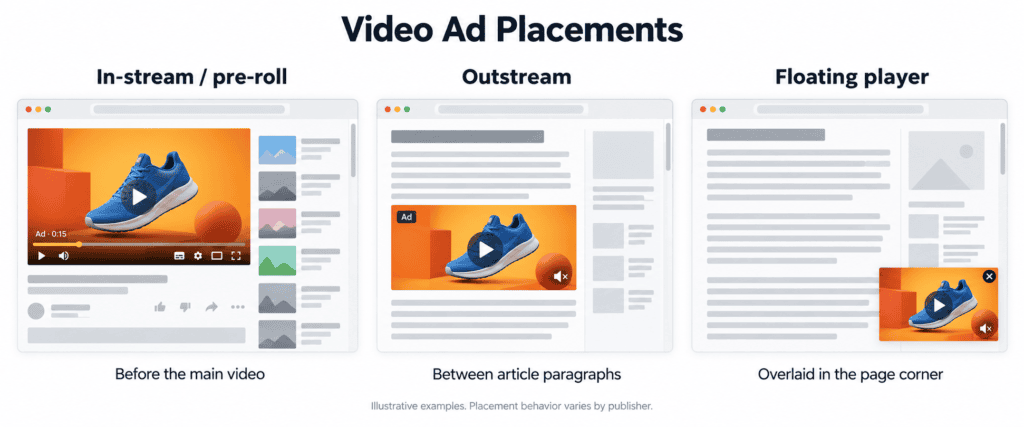
In-stream video ads play within a video player before (pre-roll), during (mid-roll), or after (post-roll) the main video content. Depending on the placement, ads may be skippable or non-skippable, with different duration limits and sound settings.
Outstream video ads appear in placements that do not require an existing player for editorial video content, such as between paragraphs of an article or within a content feed. They often start playing automatically when visible on screen, usually with sound muted. These placements can appear on websites without dedicated video content.
Video sliders and floating players are placement styles that display ads in separate video units, sometimes remaining visible as users scroll. They can appear in a corner of the screen or expand from an inline placement. Their behavior, including close and mute controls, depends on the network and publisher implementation.
When comparing video placements, check autoplay behavior, sound settings, skip options, device availability, and creative requirements.
What to Look for in a Video Ad Network
Video inventory and GEO availability. Check available video traffic in your target countries, on specific devices, and across different placements. A network’s total traffic volume may include other advertising formats. Check video-specific traffic estimates in the advertiser dashboard, if available, or request inventory details from the network.
Playback conditions and traffic quality. Review autoplay behavior, sound settings, skip options, and viewability reporting. Check how the network measures impressions, video starts, viewable impressions, and completed views. Compare these metrics alongside clicks and conversions to assess placement quality and campaign performance.
Vertical and creative restrictions. Confirm that the network accepts your offer category, particularly for Gambling, Betting, Dating, Adult, and Nutra campaigns. Review requirements for the full campaign funnel: the video creative, any prelanding page, and the final offer. Acceptance of a vertical does not guarantee approval of every promotional approach.
For examples of messaging and visual approaches, see our guide to Nutra ad creatives.
Targeting and optimization. Look for frequency capping, source or zone targeting, blacklists, whitelists, and placement-level reporting. Server-to-server (S2S) postback integration enables conversion tracking. Use source-level reporting to compare costs against the actions your affiliate program pays for, such as approved leads or first-time deposits. Where available, automated bidding and source optimization tools can reduce manual campaign adjustments.
Video Advertising Costs and Minimum Deposits
Video ad networks may offer CPM (cost per thousand impressions), CPC (cost per click), or CPV (cost per view) pricing, depending on the network and video placement. For CPV campaigns, check how the platform defines a billable view, as the required playback duration or engagement criteria may vary.
With CPM pricing, the effective cost per click depends on CTR. For example, at a $2 CPM and 0.5% CTR, the effective CPC is $0.40. If 2% of clicks convert, the projected CPA is $20. A lower CPM can still produce a higher CPA if users click or convert less often.
Minimum deposits indicate how much advertisers must initially add to their accounts. Before testing video traffic, check minimum campaign budgets, minimum and recommended bids (where available), and estimated inventory at your target bid. These conditions affect how much traffic you can realistically purchase.
Set your testing budget based on the expected cost per conversion and the number of creatives or placements you plan to test.
FAQ
Some video ad networks accept Adult, Gambling, or Betting campaigns, but policies differ by network, GEO, and placement. Approval may also depend on the video creative and landing page. Confirm that your specific offer is permitted on the selected video inventory before launching a campaign.
Yes. Video ads can be used for both CPA and RevShare campaigns when the network permits the offer. For CPA, compare acquisition costs with the payout. For RevShare, evaluate expected customer value and the time required to recover advertising costs.
Requirements depend on the network and placement. Check accepted file formats, aspect ratios, resolution, video duration, file size, and bitrate. Depending on the platform, advertisers may upload video files, provide VAST tags, or use both methods. Confirm the specifications before producing your creative.
Some networks allow advertisers to include or exclude specific source IDs or ad zones. Access to individual publisher names and placement-level targeting depends on the network. Check whether source-level reporting and whitelists or blacklists are available.
Use a tracking platform with server-to-server (S2S) postback integration where supported. Pass click IDs through tracking URLs and ensure they are returned in conversion postbacks. Use source identifiers to analyze performance by placement and compare conversion data with advertising costs to evaluate CPA.
A video ad impression is recorded when an ad meets the platform’s impression-counting requirements. A video view typically requires a specified playback duration or interaction. A viewable video impression generally requires at least 50% of the ad to be visible for two continuous seconds during playback. Check the network’s definitions before comparing these metrics.

Ratmir started his copywriting career back in 2016. He is now editor-in-chief with an MA with Honors in Linguistics.
His primary expertise is in affiliate marketing, EdTech, education, IT, and sports.
Ratmir specializes in content marketing, content management, proofreading, and translation.