

Push ad networks connect advertisers and affiliate media buyers with publishers that sell classic push traffic. The networks below are compared by GEO coverage, minimum deposit, supported verticals, targeting and optimization tools, with a focus on affiliate campaigns.
| # | Network | Since | Pricing models | GEOs | Best for verticals | Minimum deposit | Special features | More |
|---|---|---|---|---|---|---|---|---|
| 1 |
 EpicAds
|
2023 |
CPC |
Worldwide |
Betting Gambling Dating Nutra |
$50 |
Built-in spy-tool |
|
| 2 |
 Kadam
Kadam
|
2012 |
CPM CPC |
195 |
Gambling Nutra Betting Dating Crypto Sweeps |
$100 |
Microbidding CPA target |
|
| 3 |
 Clickaine
|
2016 |
CPC CPM |
195 |
Betting Gambling Nutra Dating Ecommerce Software Crypto Adult offers |
$20 |
Smart CPC Smart CPM |
|
| 4 |
 AdsCompass
|
2013 |
CPM CPC |
200+ |
Gambling Betting Dating Software |
$50 |
SST Pixel S2S Postback |
|
| 5 |
 ReachEffect
|
2014 |
CPM CPC CPA CPL |
250 |
Ecommerce Nutra Adult Gambling Dating Sweepstakes |
$100 |
API automation 20% cashback on first deposit from $500 |
|
| 6 |
 MyBid
MyBid
|
2020 |
CPM CPC CPA |
120+ |
Dating VPN Utilities Gambling Betting |
$100 |
No content or GEO restrictions |
|
| 7 |
 OctoClick
|
2018 |
CPM CPC |
120+ |
Dating Gambling Betting adult-oriented Nutra Adult |
$20 |
n/a |
|
| 8 |
 PropellerAds
|
2011 |
CPM CPC |
195 |
Finance Ecommerce Mobile Apps Utilities Software Social niches |
$100 |
SmartCPC SmartCPM CPA Goal |
|
| 9 |
 RollerAds
|
2019 |
CPM CPC |
150+ |
n/a |
$50 |
SmartCPC |
|
| 10 |
 RichAds
|
2018 |
CPM CPC CPA |
220 |
Gambling Betting Nutra Utilities Antivirus |
$150 |
Target CPA Microbidding Performance mode |
How We Selected the Best Push Ad Networks
The networks in this list were selected with affiliate media buying in mind. We looked beyond headline traffic volumes and compared where the traffic comes from, which push formats are available, the cost of getting started, and how much control advertisers have once a campaign is running.
That includes source-level data and controls such as zone IDs, whitelists and blacklists, bid adjustments, automated optimization, and postback tracking. We also considered whether a network has enough traffic and workable campaign rules for common affiliate verticals, including gambling, dating, sweepstakes, finance, and nutra.
What to Look for in a Push Ad Network
Choosing a push ad network comes down to more than headline traffic volume or minimum CPC. For affiliate campaigns, the bigger differences are usually in usable GEO coverage, source-level controls, available push formats, and how easily traffic can be optimized around the conversion events that actually generate revenue.
Traffic Volume and GEO Coverage
Headline reach matters less than usable scale in the GEOs you actually plan to target. Some networks are stronger in Tier 1 markets, while others have more volume in Tier 2 and Tier 3 countries.
For gambling, dating, sweepstakes, nutra, and similar affiliate verticals, usable volume can be much smaller than a network’s total reach suggests. Not all available inventory will be suitable for the same type of offer, and conversion rates can vary sharply between sources, especially in smaller GEOs.
Targeting and Source-Level Optimization
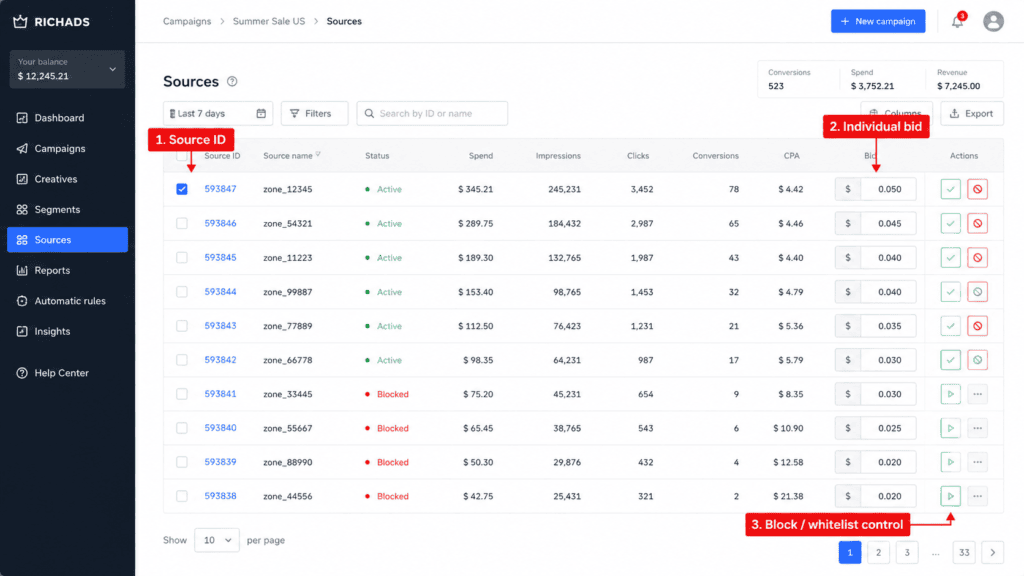
Source-level controls become critical once a campaign starts generating data. Useful features include zone or source IDs, whitelists and blacklists, device and OS targeting, bid adjustments, subscriber-age targeting, and automated rules.
Performance can vary sharply between zones even within the same GEO. If an offer converts only on a narrow group of sources, scaling the whole campaign instead of the winning zones can destroy the margin quickly. A media buyer should be able to cut weak sources, raise bids selectively, and build whitelists around traffic that converts consistently.
Push Formats
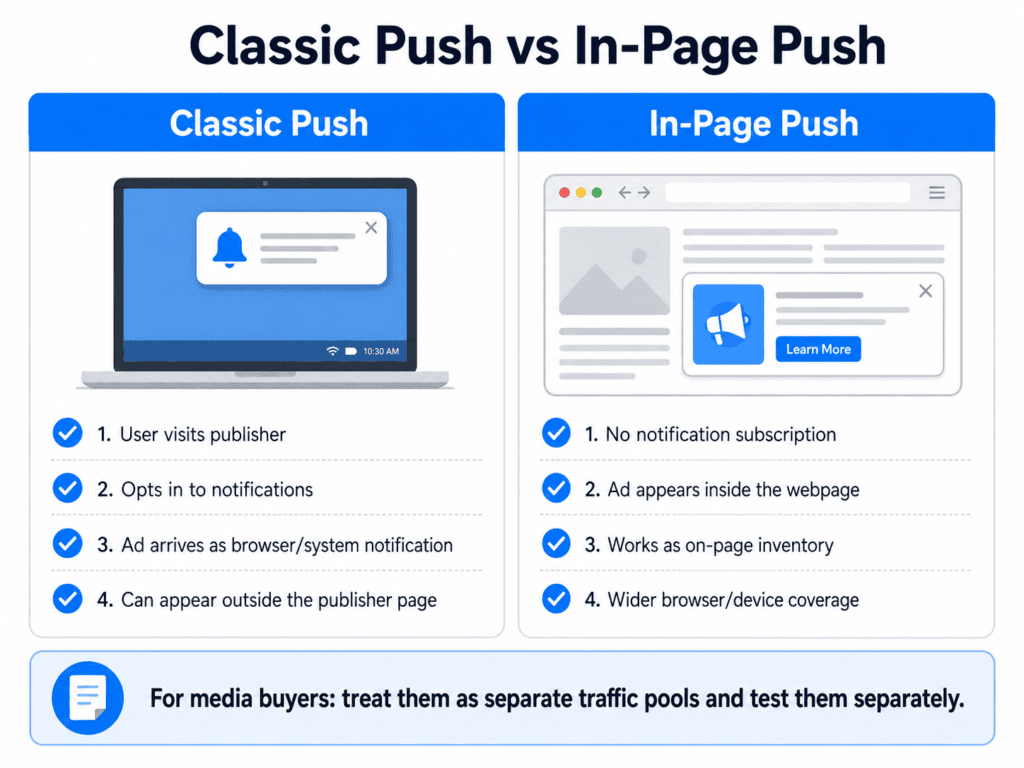
Classic push and in-page push should be treated as separate traffic pools rather than interchangeable formats. Their availability can differ by browser, device, and network, and the same offer may perform very differently across the two.
Access to both gives affiliates more inventory to test. Testing them separately also prevents strong performance in one traffic pool from hiding weak results in the other.
Traffic Quality and Filtering
Traffic quality should be judged by the events that generate revenue, not cheap clicks or CTR alone. A source can deliver a high CTR while producing almost no registrations, deposits, purchases, or other valuable conversion events.
This matters especially when the payout depends on deeper-funnel actions such as deposits or purchases. Source IDs and postback data make it easier to identify profitable zones, blacklist traffic that fails to convert, and optimize using downstream conversion data.
Best Push Ad Networks by Use Case
There is no single push network that fits every affiliate campaign. A more practical approach is to match the network to the offer, GEO, payout model, and the type of optimization the campaign will require.
| Campaign / Use Case | Network to Consider | Why |
|---|---|---|
| Tier 2 mainstream dating | EpicAds | Dating inventory in BR, MX, TR, and PL; useful for SOI/CPA testing |
| iGaming focused on FTDs | Kadam | CPA optimization, retargeting, and deeper-funnel work beyond registration |
| Sweepstakes / lead gen: Tier 3 → Tier 2 | Clickaine | Cheap GEO testing first, then scaling winning setups into Tier 2 |
| Android utilities | PropellerAds | Push + CPA Goal with published cleaner/VPN campaign data |
| US mobile sweepstakes | RollerAds | Android Push, SmartCPC, and source-level optimization |
| COD Nutra | RichAds | Target CPA, microbidding, rules, whitelists, and call-center scheduling |
EpicAds — worth testing for mainstream dating in Tier 2 GEOs. EpicAds highlights Brazil, Mexico, Turkey, and Poland among its stronger Tier 2 markets for mainstream dating. This setup is particularly relevant for SOI and CPA funnels, where lower traffic costs can leave more room for testing creatives and individual sources before scaling. Epic SPY also lets buyers research ads by GEO, format, and vertical.
Kadam — a logical candidate for iGaming optimized beyond registration. Kadam supports Push and In-Page Push alongside retargeting scenarios built around FTDs, repeat deposits, and player reactivation. That makes it more interesting for campaigns where a registration alone has little value and optimization needs to follow users deeper into the iGaming affiliate funnel.
Clickaine — worth considering for Tier 3-to-Tier 2 sweepstakes testing. Clickaine’s own GEO strategy recommends testing sweepstakes and lead-generation funnels in cheaper Tier 3 markets before moving successful setups into Tier 2. The advantage of this approach is not simply cheap clicks: it gives affiliates more room to test GEO, creative, and landing-page combinations before committing a larger budget.
PropellerAds — an obvious test candidate for Android utilities. PropellerAds has published advertiser cases around cleaners, VPNs, and similar mobile utility offers using Push, OnClick, and CPA Goal across GEOs including India, the US, Brazil, and South Africa. One such case reported more than 1.19 million conversions, although that should be treated as a vendor-published campaign result rather than a general performance benchmark. For CPI and CPA utility offers, the combination of large mobile inventory and conversion-based optimization makes the network worth including in an initial test.
RollerAds — worth testing for Tier 1 mobile sweepstakes. RollerAds has published a US mobile sweepstakes case using Android Push traffic and SmartCPC. This makes it a more specific use case than simply “cheap lead generation”: the interesting angle is testing a short CPL funnel on higher-cost Tier 1 traffic while using bidding and source controls to narrow the campaign after the initial data comes in.
RichAds — a logical fit for COD Nutra. COD nutra campaigns are judged further down the funnel than the initial order, so call-center schedules, approval rates, and source quality matter more than raw lead volume. RichAds specifically discusses scheduling Nutra traffic around call-center hours and provides tools such as Target CPA, Micro Bidding, automated rules, and source-level whitelisting. That makes it worth testing when the goal is to optimize toward approved sales rather than simply generate the cheapest orders.
These examples are starting points, not fixed rankings. The useful question is not which push network is best overall, but which one gives a particular offer enough usable traffic, acceptable campaign rules, and the right optimization controls in the target GEO.
How Much Does Push Traffic Cost?
Several networks in this list advertise minimum Push bids as low as $0.001–$0.005 CPC, while published GEO benchmarks can reach $0.20+ in competitive Tier 1 markets. These lower figures are minimum bid floors, not guaranteed buying prices.
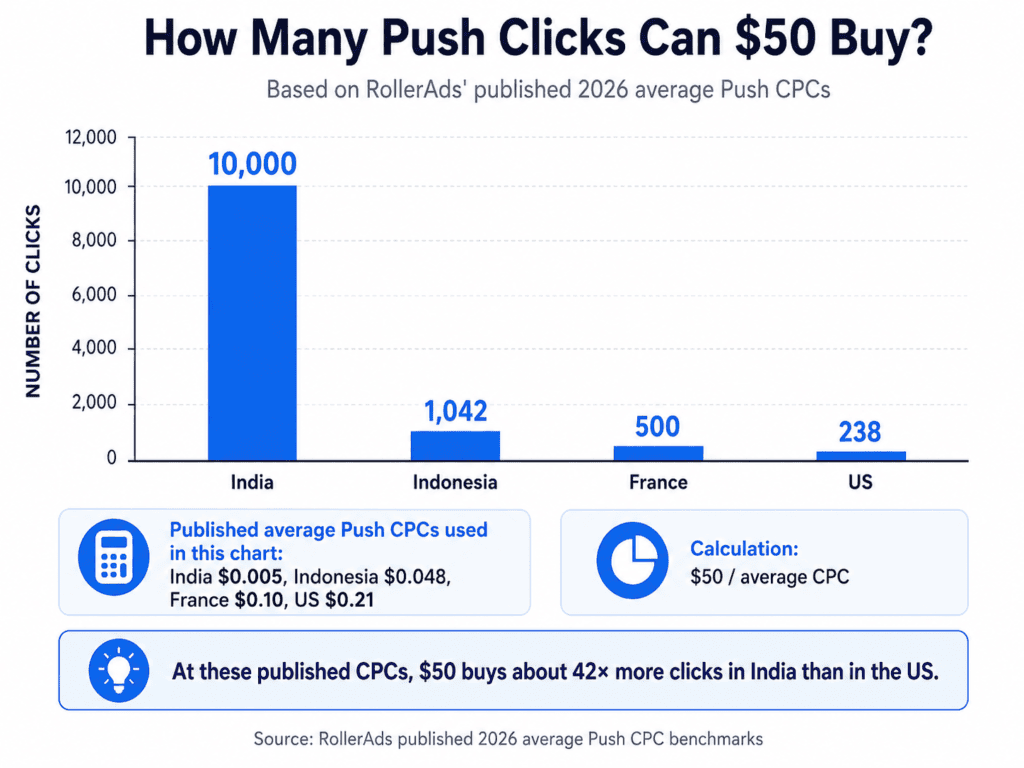
Network benchmarks published in 2026 show how wide the spread can be. RollerAds reports average Push CPCs of roughly $0.005 in India, $0.048 in Indonesia, $0.10 in France, and $0.21 in the US. RichAds publishes figures of about $0.010 in India, $0.019 in Mexico, $0.029 in Poland, $0.057 in Brazil, and $0.094 in Japan. These are separate vendor-published benchmarks rather than a single market average, but they show how sharply costs can change by GEO. On RollerAds alone, the reported US CPC is around 40 times higher than the India rate.
For affiliates, the useful number is the break-even CPC, not the cheapest available click. As a simple example, an offer paying $80 per FTD with a 0.5% click-to-deposit conversion rate has a theoretical break-even CPC of $0.40 before other costs. A $2 CPL offer converting 3% of clicks into qualified leads breaks even at $0.06 CPC. In practice, the CPC needs to stay below break-even to leave room for profit, tracking discrepancies, rejected or unqualified conversions, and underperforming sources.
Account funding requirements also vary. Clickaine has advertised a $20 minimum deposit, AdsCompass and RollerAds start at $50, while RichAds currently requires $150. These are account funding thresholds, not realistic campaign budgets.
The difference becomes obvious when the same $50 spend is applied to RollerAds’ published GEO averages. At $0.005 CPC in India, it would buy roughly 10,000 clicks; at $0.048 in Indonesia, about 1,040 clicks; at $0.10 in France, around 500 clicks; and at $0.21 in the US, only about 238 clicks. Whether any of those samples is large enough to judge a campaign depends on the payout and the conversion rate of the event that actually generates revenue.
FAQ
Do not judge a source by CTR alone. A zone can generate cheap clicks and still lose money if registrations, deposits, approved sales, or other paid events do not follow. If a source has already spent close to one expected payout without producing a paid conversion, it deserves closer scrutiny; with enough traffic and no downstream signals, it is usually a candidate for blacklisting.
Several networks in this list work with gambling and dating offers, including EpicAds, Kadam, Clickaine, and RichAds. However, “vertical allowed” does not automatically mean full inventory access: individual GEOs, creative angles, landing-page types, and offer categories may still be restricted.
Yes, if you want clean performance data. Classic Push and In-Page Push use different inventory pools and can differ in CPC, device coverage, CTR, and downstream conversion rate. Keeping them separate makes it easier to see which format is actually generating profitable conversions instead of letting strong results from one hide weak performance in the other.
There is no fixed number. A source with one conversion may still be unprofitable, while cutting a high-payout source after a few clicks can remove a potential winner before enough data is collected. The lower the conversion rate and the higher the payout, the larger the sample usually needs to be before a zone can be judged with confidence.
Start with one network long enough to understand whether the offer can produce viable economics there, then test a second network before drawing conclusions about push as a traffic source. Different networks can expose completely different source pools, so a setup that fails on one platform may still work elsewhere.

Ratmir started his copywriting career back in 2016. He is now editor-in-chief with an MA with Honors in Linguistics.
His primary expertise is in affiliate marketing, EdTech, education, IT, and sports.
Ratmir specializes in content marketing, content management, proofreading, and translation.