
In 2026, AI has become a real tool that saves hours of routine work and helps test hypotheses faster. This is especially noticeable in affiliate marketing — today, affiliates create custom GPT bots, build their own AI agents, and automate push generation and account farming. This article is a practical guide on how to use AI in affiliate marketing — with workflows and templates.
- AI Time-Savers for Affiliates
- Localized Asset Generation
- Ad Creative Validation
- Analytics and Reporting
- Offer Research
- Key Insight
- Using Custom GPTs in Affiliate Marketing in 2026
- Common Use Cases
- Setup and Configuration
- Practical Impact
- Create and Set Up an AI Agent for Affiliate Purposes
- What AI Agents Handle
- Agent Setup and Tooling
- Example: Gambling Affiliate Workflow
- AI Agents and Custom Bots in Practice
- How AI Is Used Inside a Bundle
- Practical Example: Push Creative Testing
- Where AI Breaks in Affiliate Marketing
- Common Mistakes Affiliates Make When Using AI
- Conclusion
- FAQ
AI Time-Savers for Affiliates
AI in affiliate marketing is not a universal solution, but it helps reduce time spent on some repetitive tasks.
Localized Asset Generation
When one offer is launched across multiple GEOs, ad creatives usually have to be rewritten for each market.
GPT handles this automatically by adapting:
- currency and numeric formats;
- local context or news-style hooks;
- spelling conventions and language nuances;
- commonly used names and triggers.
While the output may look similar at first glance, each version is linguistically adjusted to the target GEO rather than copied verbatim.
Ad Creative Validation
AI agents and GPT-based scripts are often used as a preliminary filter before moderation.
They can:
- identify the core angle used in a creative (for example, greed, case study, or secrecy);
- suggest alternative angles based on the same logic;
- flag or remove words that may cause moderation issues.
This step doesn’t replace review, but reduces the number of creatives that fail basic checks.
Analytics and Reporting
When bundles are tracked in spreadsheets, GPT can assist with routine analysis.
Typical use cases include spotting recurring patterns, building hypotheses based on performance data, and identifying early signs of creative burnout from historical trends.
Occasional misinterpretation of requests happens when context is lost. In such cases, refining the prompt usually resolves the issue.
Offer Research
GPT-based bots are also used during offer selection and evaluation.
They can monitor offer listings, analyze descriptions, compare payout conditions, and highlight potential weak points such as restrictive rules or creatives that consistently underperform.
Key Insight
Using AI doesn’t remove control from the affiliate. It executes the same actions already performed manually, but faster and with less overhead.
If the bundle logic is clear, AI accelerates execution. If it isn’t, automation won’t prevent wasted budget.
Using Custom GPTs in Affiliate Marketing in 2026
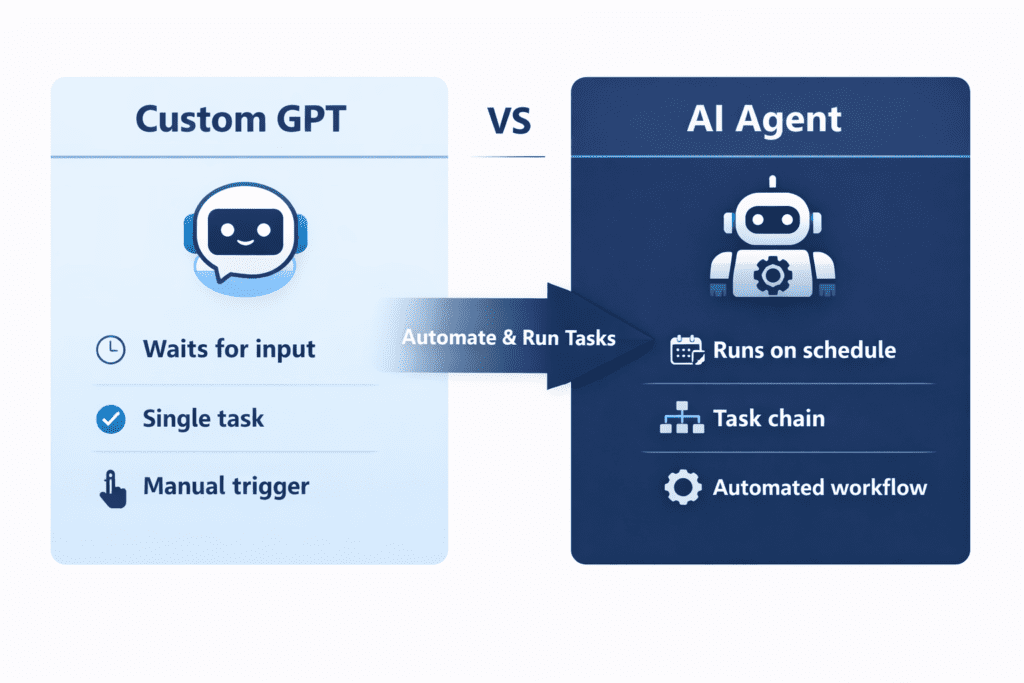
The default ChatGPT is no longer the limit. Today, many affiliates create custom GPT versions — personalized bots trained for a specific task.
Creating such a GPT is done directly inside ChatGPT’s interface and requires a Plus subscription. After that, the Explore GPTs → Create flow allows you to configure a bot through a step-by-step builder.
Common Use Cases
- A bot that recognizes trending ad creative angles.
- An assistant that analyzes offers to collect pros, restrictions, and target audiences.
- A push generator that adapts messages to different GEOs.
Setup and Configuration
Affiliates start by defining roles and goals. For example: “You are a gambling offers expert. Help evaluate a bundle based on this brief.”
Relevant data is then uploaded — PDFs with offers, landing page screenshots, or text briefs.
Different scenarios are tested: one GPT may handle account farming tasks, another focuses on Facebook headline generation.
Once configured, the GPT is saved as a separate assistant. It retains working logic and adapts to the user’s tone and workflow.
Practical Impact
This approach removes the need to repeat the same instructions, keeps the bot aligned with a specific methodology, and allows routine tasks to scale — for example, generating push texts for multiple offers at once. All of this works without any coding and is handled entirely through the interface. Many affiliates use such GPTs daily to offload routine work and avoid keeping operational details in memory.
Click here to download a step-by-step guide to create a custom GPT bot for your affiliate tasks.
Create and Set Up an AI Agent for Affiliate Purposes
AI agents are used for tasks that must run without manual input. Unlike custom GPTs, they don’t wait for commands and execute predefined task chains based on a fixed scenario.
What AI Agents Handle
- Monitor offer listings and notify about new promotions.
- Check landing pages for availability, 404 errors, or offer changes.
- Collect ad creatives from selected sources and sort them by basic parameters such as date or repetition.
- Generate regular reports highlighting creative fatigue, CTR drops, and headlines that require replacement.
Agent Setup and Tooling
AI agents are typically built from existing components rather than developed from scratch.
- AutoGPT / AgentGPT are used to launch and manage task chains based on prompts, APIs, and contextual memory.
- Make, Zapier, or Pabbly connect services into a single flow, for example: a spy tool → Notion → a Telegram bot.
- GPT-based chat agents with external APIs can access ad libraries, extract data, analyze copy, and forward selected results to internal channels.
Most setups rely on built-in GPT tools such as WebPilot for site access, Code Interpreter for working with tables and numbers, and browsing capabilities when available. Together, these elements allow affiliates to assemble simple automation pipelines similar to internal reporting or BI workflows.
Example: Gambling Affiliate Workflow
In gambling campaigns, AI agents are commonly used at the offer and creative preparation stage.
On a schedule, an agent scans gambling offer listings and relevant Telegram channels, then checks offer availability and key parameters via API. If an offer meets predefined criteria, such as payout level or GEO availability, the data is passed to a GPT-based assistant that generates several push notification drafts.
The prepared creatives are sent to Notion, where an affiliate reviews compliance, adjusts angles if needed, and sends them to launch.
As a result, routine preparation is automated, while manual work is limited to control and final approval.
Our PDF file with a complete guide on how to create an AI agent for affiliate marketing — download.
AI Agents and Custom Bots in Practice
AI can’t choose offers, allocate budgets, or decide where traffic should go. Its role is limited to routine execution and preparation tasks inside a bundle, and this is where it delivers the most value.
How AI Is Used Inside a Bundle
- Writing copy for offers: push notifications, banners, pre-lander titles, and supporting texts.
- Adapting banners to different formats and sizes.
- Grouping creatives by logic or angle, such as FOMO-based messages or news-style hooks.
- Filtering bundles by predefined metrics, for example ROI above a set threshold or minimum LTV in spreadsheets.
In practice, text generation is the most common use case. GPT-based tools are used to prepare pushes, headlines, posts, and landing content, with localization by GEO, language, and offer parameters.
Practical Example: Push Creative Testing
A typical setup looks like this:
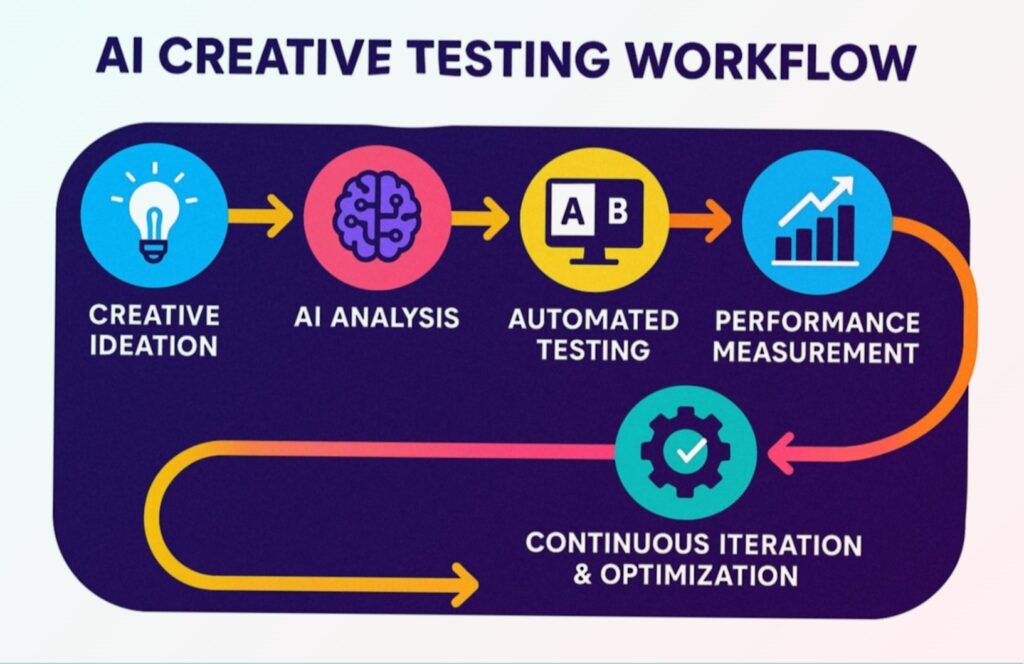
You launch a gambling campaign targeting a country and define the offer and ad format, such as push traffic. GPT generates several text variants using different hooks and calls to action. These variants are tested in live traffic, CTR is tracked, and underperforming options are discarded. The best-performing creative is then refined and reused.
What previously required a full day of manual work is reduced to a short preparation cycle.
As a result, affiliates spend less time on routine creative production and more time analyzing performance and optimizing bundles.
Where AI Breaks in Affiliate Marketing
AI works best with clean inputs and repeatable logic. When these conditions are missing, automation becomes unreliable.
- Ambiguous data. Dirty trackers, inconsistent metrics, or broken reports lead to incorrect conclusions. AI can’t compensate for missing or distorted inputs.
- Compliance-heavy offers. Gambling and regulated GEOs require context, legal awareness, and moderation nuance. AI can assist with preparation, but full automation increases risk.
- Early-stage testing. Without historical data, AI has no baseline. At this stage, assumptions are often wrong and outputs are generic.
- Budget-driven decisions. Under tight budget pressure, timing and judgment matter more than pattern recognition. AI doesn’t understand urgency or risk tolerance.
In these scenarios, AI support should remain limited and closely supervised.
Common Mistakes Affiliates Make When Using AI
Most AI-related failures in affiliate marketing are operational. They appear when automation is applied to parts of the workflow that still require your control.
- Using AI for strategic decisions. GPT is used to choose offers, GEOs, angles, or scaling points without access to live traffic signals, account history, or real budget constraints.
- Automating before bundle logic is defined. AI is launched without clear testing goals, success metrics, spend limits, or stop rules, which leads to optimizing noise instead of performance.
- Trusting AI output without manual review. Generated creatives and conclusions are accepted as final, increasing moderation risk and account bans in gambling and other regulated verticals.
- Feeding AI inconsistent or broken tracking data. Tracker mismatches, delayed postbacks, and mixed attribution models result in confident but incorrect insights.
- Automating too early in the testing phase. AI is applied before any stable CTR, CR, or retention baseline exists, producing generic angles and recycled hooks.
- Scaling automation before stability. Agents are deployed at volume before the bundle proves consistent results, accelerating budget burn and amplifying mistakes.
Conclusion
AI in affiliate marketing reduces manual work and accelerates processes where logic is already defined. If performance doesn’t improve, the issue is usually the offer or the ad creative, not the tool itself. Eventually, it doesn’t fix weak bundles.
Custom GPTs and agents act as assistants, handling routine tasks. No coding is required — clear task definition is enough to gain a practical operational advantage.
FAQ
Yes — you can create a GPT inside their “Create GPT” interface. No code or technical skills required.
Start with routine tasks: push generation, localization, translations, banned-word checks, and offer research.
No. But AI agents and APIs can automate parts of the workflow — like rotating ad creatives when CTR drops.
Basic ones exist for pushes and offer research, but the most useful templates are usually private: old chats, saved prompts, personal archives.
The main risk is overestimating AI. It won’t fix bad offers, bad ad creatives, or bans. It’s a tool — not a shortcut to profitability.
Yes — GPT can generate scripts, hooks, and angles. Visuals can be produced with AI video tools or UGC-style editors.

Ksenia has extensive hands-on experience in affiliate marketing, having worked as a media buyer and affiliate for several years across multiple verticals. Throughout her career, she managed traffic from a wide range of sources, tested funnels, and collaborated directly with advertisers and networks.
For the past six years, she has also been writing in-depth articles, reviews, and analytical guides about affiliate marketing. Her work has appeared on well-known industry blogs and platforms, where she covers topics such as traffic sources, compliance, creatives, tracking, and campaign optimization.
Today, Ksenia combines practical experience with editorial expertise, contributing as a guest expert to various affiliate marketing projects and helping educate both beginners and experienced affiliates.

Ratmir started his copywriting career back in 2016. He is now editor-in-chief with an MA with Honors in Linguistics.
His primary expertise is in affiliate marketing, EdTech, education, IT, and sports.
Ratmir specializes in content marketing, content management, proofreading, and translation.