

Affiliate marketing tools are the software and services affiliates use to launch campaigns, track performance, pay for services, and operate in policy-sensitive niches. They matter because accounts, attribution, payments, and creatives break at scale — and the right tools help you save time, reduce waste, and scale more consistently.
Anti-Detect Browsers
-
1

Designed for multi-accounting and web scraping
Bypasses checkers and protection systems like Pixelscan, BrowserLeaks, and CreepJS
Prices start from 29 EUR per month -
2

Prices start from $9 per month
Designed for simultaneous management of multiple accounts on various social networks, advertising platforms, etc
Creates unique browser fingerprints for each account -
3

Prices start from $24 per month
Free plan with limited functions and sessions is available
Good for managing a network of channels on social medias; for bonus hunting, multi-accounting, and simple secure internet browsing
Virtual Cards
-
1

Available currencies: USD, EUR, GBP
Variety of BINs and cards with 3DS security
Is oriented towards affiliate teams and large IT companies -
2

Mass payments, multi-currency transactions
Supports crypto
Card issuance costs $5
Monthly service fee is $5 -
3

Two types of cards: limited and cards with a shared balance
Card issuance fee: from $0
Balance top-up fee: 3%
Offers 40+ trusted BINs from the US, Estonia, the UK, and Hong Kong
Agency Ad Accounts Vendors
-
1

Google Ads accounts
Tier-1 based
Multiple tools included
Support team available -
2

Designed for Finance, Insurance, e-Commerce, and iGaming niches
Supports 100+ GEOs
The team of experts optimizes advertising networks for clients and analyzes audience behavior across more than 20 parameters
Cloaking Tools
-
1

Deep filtering customization
Good for Facebook, TikTok, MyTarget, and some others
Provides detailed statistics
Proxy Servers
-
1

Over 400,000 proxies
120+ GEOs
Prices start from $10
Test plan for $1
Moneyback for most plans available
SaaS Platforms
-
1

SaaS platform for creating affiliate programs and CPA networks
Offers customizable functionality
Why Affiliates Use Affiliate Marketing Tools
Affiliates use affiliate marketing tools because margins are thin and the environment is hostile: platforms tighten rules, accounts get reviewed or restricted, payments fail, tracking breaks, and a profitable setup can die overnight. Tools help you control the variables that directly impact ROI — keeping operations stable at scale, reducing wasted spend from technical failures and human error, protecting key assets (accounts, payment rails, data), and moving faster when you need to test, iterate, and switch setups. In practice, affiliate marketing tools are less about “convenience” and more about survival: minimizing downtime, keeping attribution clean, and turning chaos into a repeatable process you can scale.
Types of Affiliate Marketing Tools
Affiliate marketing tools solve different operational problems, so it’s easier to think in categories rather than brand names. The table below breaks down the core tool types, what each one is used for, and what to check before you pay.
| Tools | What it solves | Typical use cases | Price reality |
|---|---|---|---|
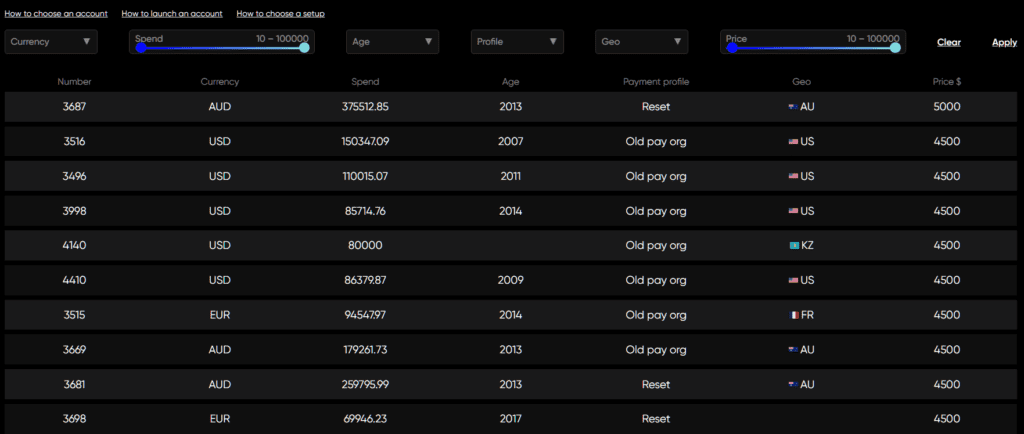
| Ready-Made Accounts Vendors | Saves time and reduces friction when creating/stabilizing assets is slow or unreliable | Fast launches, scaling tests, replacing restricted/limited assets | Usually mid–high; quality and replacement terms matter more than the cheapest unit price |
| Anti-Detect Browsers | Separates identities/workspaces so multi-account operations stay organized and stable | Managing multiple ad/social accounts, team workspaces, profile cloning | Low–mid monthly; costs grow with team seats and cloud sync features |
| Virtual Cards | Structures spend and reduces billing friction across campaigns/platforms | Budget segmentation, per-campaign limits, team spend control | Ranges widely; “cheap” often hides costs in fees/declines |
| Cloaking Tools | Controls routing and protects funnels from unwanted attention and disruptive checks | Routing logic, monitoring access patterns, fallback pages, traffic control | Mid; price is justified when downtime or burns are expensive |
| Proxy Servers | Provides IP routing and stability for environments and sessions | Geo routing, stable sessions, scaling environments | From cheap to expensive; stable/clean supply costs more but saves time and failed launches |
Are Affiliate Marketing Tools Always Expensive?
In affiliate marketing, tool pricing mostly reflects risk transfer and stability, not “more features.” With ready-made accounts, you’re paying for speed and survival rate: region/history/limits matter, but the real price driver is the warranty layer — replacement rules, money transfer from one account to another, and how consistently batches work. With anti-detect browsers, cost is about reliability at scale: stable profiles after updates, cloud sync, team roles, and predictable fingerprinting — cheap tools often “work” until you manage many profiles and waste hours rebuilding environments.
For proxy servers, cheap usually means unstable supply: noisy IP ranges, uneven uptime/speed, throttling, or rotation that doesn’t match your workflow. Plan type matters (per-IP vs per-GB) because it changes the real cost once you scale. Virtual cards are rarely about the headline fee — real costs show up in declines, top-up friction, FX/processing fees, BIN/region options, KYC rules, and how fast issues get resolved when spend is interrupted. Cloaking tools are priced around infrastructure and maintenance: request volume, filtering accuracy, logging, uptime, and the ability to adjust fast when scrutiny increases. The smart approach isn’t “premium everything,” but paying more in the areas where failure is costly — assets, payment continuity, and routing/control — while keeping the rest lean until you have a clear reason to upgrade.
How to Choose Good Affiliate Tools
Ready-made accounts vendors: don’t buy “account type,” buy the vendor’s process. Define what “working” means (login-only vs spendable/verified), ask for DOA terms, replacement rules, proof requirements, and whether quality is consistent across batches. Cheap vendors with slow/no replacements usually cost more in downtime.
Anti-detect browsers: prioritize stability over time. You want predictable fingerprints after updates, clean profile isolation, reliable cloud sync/backups, and easy export/import. For teams: roles, sharing, and activity logs. If updates regularly break sessions or force relogs, you’ll pay in rebuilds.
Proxy servers: quality = consistent routes under load, not a speed test. Check uptime/latency, geo accuracy, static vs rotating behavior, and clear replacement terms when IPs degrade. Pricing model matters: per-GB can spike with volume; per-IP gets expensive when you need clean capacity.
Virtual cards: optimize for spend continuity. Real costs are declines, top-up friction, FX/processing fees, BIN/region limits, and KYC that can freeze funds. Ask what triggers extra verification and how incidents are handled when payments fail.
Cloaking tools: buy control + visibility: filtering accuracy, real-time logs, safe fallback behavior, quick rule changes, and uptime at your traffic volume. Avoid black boxes with weak documentation and unclear routing decisions.
Risks Associated with Affiliate Tools Vendors
A lot of service providers in affiliate marketing are not that regulated, so shady practices can take place.
Ready-made accounts vendors carry a “dirty supply” risk because large, documented criminal marketplaces have sold packages of stolen account access credentials (email, banking, social) taken from malware-infected devices. That same ecosystem also includes stolen device credentials and session material (for example, authentication cookies) that can enable session hijacking, which is why access can later be reclaimed or invalidated.
Virtual cards have a fraud-rail risk because stolen credit card data is traded at scale (UniCC described as a major market for stolen cards, for instance) and carding operations exist specifically to test stolen card credentials. When compromised credentials are used in card-not-present flows, fraudulent charges commonly end in chargebacks and downstream enforcement actions by issuers/processors.
Anti-detect browsers can “not work” in practice because bot/fraud defenses can detect fingerprint inconsistencies introduced by spoofing, and a large-scale academic evaluation shows evasive services often alter fingerprint attributes in inconsistent ways that can be used for detection and to reduce evasion rates.
Proxy servers (especially “residential” supply) carry both stability risk and sourcing risk, because researchers have documented Android apps and libraries that quietly enroll devices into proxy networks (i.e., turning users into proxy nodes) and these networks are then used for abuse like ad fraud. Security vendors also explicitly discuss the organizational risks of residential proxies and proxyware, which is why “residential” can sometimes mean “questionable supply chain,” not just a different product tier.
Cloaking tools have an explicit enforcement risk because Google Search defines cloaking as showing different content to users vs search engines (as a spam policy issue), and Google Ads explicitly says cloaking isn’t allowed under its Circumventing systems policy.
FAQ
Affiliate marketing tools are software and services that help affiliates run campaigns: tracking and attribution, link management, traffic operations, payments, multi-account workflows, and basic automation. The goal is simple: fewer failures (tracking loss, payment issues, access problems) and faster testing.
For beginners, the best affiliate marketing tools are usually the “baseline stack”: analytics, link management, and click tracking. If you plan to run paid traffic, add a tracker with postback/S2S and a stable billing method before you spend time on advanced tools.
SEO/content: analytics + link management + click tracking (optional: lightweight tracker for outbound attribution).
Paid traffic: tracker with postback/S2S + reliable billing + a clean account workflow.
Proxies/anti-detect/agency accounts are “scaling tools” when you operate multiple accounts, teams, or platforms.
Analytics shows on-site behavior, but affiliate marketing tools like trackers connect click → redirect chain → conversion and can send conversion data back to ad platforms via postback/S2S. If you buy traffic and optimize campaigns, a tracker is the more direct tool.
Pick affiliate marketing tools based on constraints you can verify:
1. integrations you actually need (postback, pixels, connectors),
2. pricing unit you scale on (profiles/seats, GB/ports, events),
3. support response time (real SLA),
4. exportability (can you migrate settings/data?),
5. clear rules (refunds, replacements, KYC/billing terms).
They can be cheap at entry and expensive at scale. Most affiliate marketing tools become costly when your unit grows: more seats/profiles, more tracked events, more proxy traffic, more billing volume. Compare tools by the real unit you will scale on, not by the starting plan.
If you run multiple accounts, the affiliate marketing tools that matter are environment isolation (separate profiles/storage), stable access (reliable sessions), and team controls (roles, sharing, logs). Use them to reduce account linkage and operational mistakes—especially when several people touch the same workflows.
Payment-focused affiliate marketing tools (virtual cards/billing solutions) matter when ad spend scaling is limited by declines, KYC limits, fees, or top-up reliability. Before committing, verify supported merchants (your ad platforms), limits, top-up method, FX/fees, and incident resolution speed.
The biggest risks are operational: tracking loss, downtime, unstable access, payment failures, and—depending on category—policy/compliance exposure. Treat affiliate marketing tools like infrastructure: test small, document configs, and keep a fallback (backup billing, alternative proxy pool, exportable tracking setup).
Run a narrow pilot: one GEO + one traffic source + one funnel. For affiliate marketing tools, the pass/fail criteria should be: stability (uptime/session quality), reproducibility (setup works consistently), and support (response on real issues). For vendor services (accounts/cards), test the full loop: onboarding → spend → tracking → incident handling.

Ratmir started his copywriting career back in 2016. He is now editor-in-chief with an MA with Honors in Linguistics.
His primary expertise is in affiliate marketing, EdTech, education, IT, and sports.
Ratmir specializes in content marketing, content management, proofreading, and translation.