

Latin America is one of the fastest-growing iGaming regions in the world and one of the most misread. Many media buyers and casino operators treat it as a single geo. Yet it’s rather a group of separate markets with different rules, payment habits, languages, and player behaviors, each moving at its own pace.
The region’s online gambling market generated about USD 5.33 billion in 2024. Projections range from USD 10.41 billion to USD 13.48 billion by 2030, which points to roughly 11.9% annual growth between 2025 and 2030. For a region with 662 million people and 82% internet penetration, that’s still early stage.
Large audience, rising connectivity, low per capita GGR — growth potential is high. Competition is rising, but the market is not crowded yet. Read on to get a detailed guide on LatAm iGaming marketing for media buyers and affiliates.
- Market Profile: Languages, Demographics, and Digital Infrastructure
- Languages
- Population and Internet Access
- Age and Gender Profile
- Payment Methods and Technologies: What Actually Converts
- Payment Methods by Country
- What This Means for Your Creative and Landing Pages
- Regulation Map: Where You Can Work and Where the Risk Is
- Tier 1: Regulated and Enforcement-Active
- Brazil
- Colombia
- Tier 2: Structured but Developing
- Peru
- Tier 3: Complex or Fragmented
- Mexico
- Argentina
- Tier 4: Restricted, Closed, or Pending Regulation
- Uruguay
- Chile
- Paraguay and Ecuador
- Costa Rica, Guatemala, Nicaragua, and Venezuela: Special Cases
- Country-by-Country iGaming Comparison for LatAm
- What Actually Works: How to Promote Gambling Offers in LatAm
- Brazil: Football, PIX, and Mass-Market Volume
- Colombia: Compliance as the Creative Hook
- Mexico: Volume Through Vouchers and Mass-Market Spanish
- Peru: Local Payment Education Pays Off
- Chile and Argentina: Premium Positioning and Provincial Complexity
- What Creatives to Use in Promo Campaigns: Examples for LatAm
- What LatAm Users Respond To
- What Does Not Work
- Influencer and Community Channels
- Summary
Market Profile: Languages, Demographics, and Digital Infrastructure
Let’s take a look at the main information regarding the iGaming market in LatAm.
Languages
Portuguese is the mandatory language for Brazil — the region’s single largest and fastest-growing regulated market. Across the rest of LatAm, Spanish is the default, but that masks significant variation.
For instance, the Spanish language differs in Colombia, Mexico, Argentina, and Peru in terms of vocabulary, tone, and register — enough to make a generic “LatAm Spanish” creative underperform in any one market it targets.
Population and Internet Access
Latin America has about 662 million people, with roughly 82% internet penetration. Smartphone usage averages around 60%, with clear gaps between countries. Brazil, Chile, and Argentina lead. Paraguay and Ecuador trail.
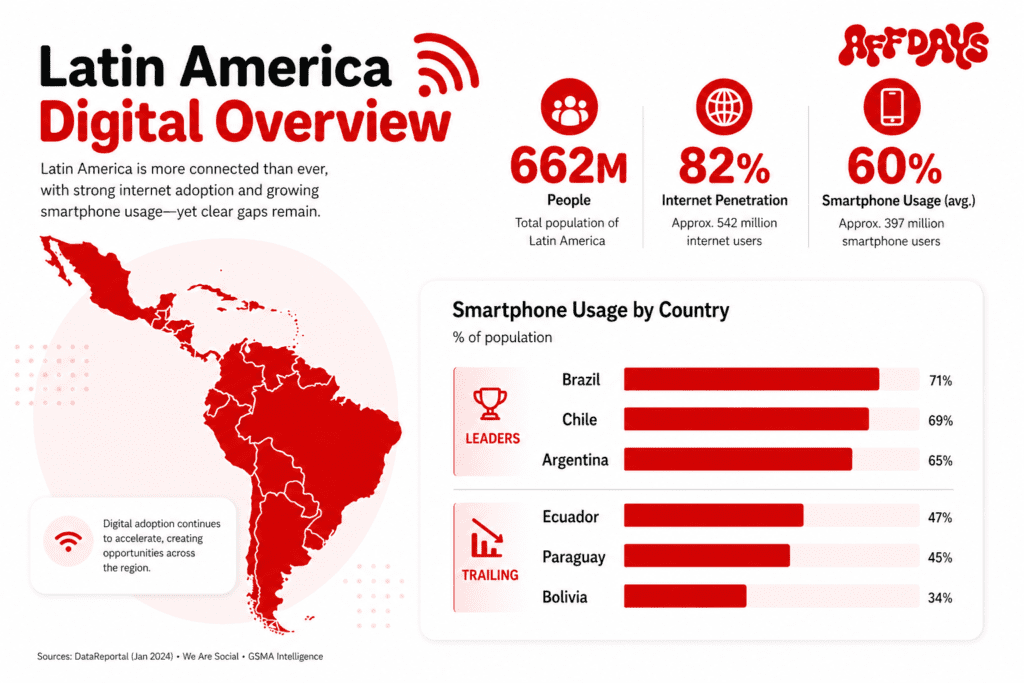
Therefore, mobile-first execution is the baseline. Desktop-only funnels will miss a large share of traffic.
Age and Gender Profile
Data from Brazil, the most documented market in the region, shows an average player age of around 39. The core group sits between 25 and 40. The audience is still mostly male, but female participation is rising, especially in mobile gaming and social casino formats.
This is important for creatives: generically masculine football-only creatives leave growing female audiences cold. Markets like Colombia and Brazil are already seeing female-skewing campaigns perform in certain verticals, particularly crash games, bingo, and social-style formats.
Payment Methods and Technologies: What Actually Converts
Payment friction is the main conversion killer in LatAm. Bonuses, creative, and brand matter less at the deposit step. If users do not see a payment method they trust, they leave. This pattern shows up consistently across operator and affiliate data.
Digital payments now account for about 60% of consumer spending in the region, with cash use dropping over the past three years. Cash still plays a role through vouchers and agent-based deposits, especially in Mexico and parts of Colombia and Peru.
Payment Methods by Country
Let’s take a look at the main payment methods in each country within the region.
| Country | Dominant Payment Rail | Cash-In Mechanism | Notes for Media Buyers |
|---|---|---|---|
| Brazil | PIX (instant transfer) | Boleto Bancário | PIX has become the default; creatives that mention PIX payouts convert better |
| Colombia | Daviplata, PSE bank transfer | Efecty (cash voucher) | Compliance messaging around known rails reduces friction significantly |
| Mexico | SPEI bank transfer | OXXO voucher | OXXO is critical for the unbanked segment — don’t skip it in your payment copy |
| Peru | Yape, PLIN (mobile wallets) | PagoEfectivo | Mobile wallet penetration is high; mention Yape by name in creatives |
| Chile | Webpay (card-based) | MACH (prepaid) | Card penetration is higher here than in most of LatAm |
| Argentina | Mercado Pago | Rapipago, Pago Fácil | Currency instability affects deposit behavior; faster payouts are a strong hook |
| Costa Rica | Mercado Pago, PayPal, international cards | Crypto (BTC, USDT) | Local banks avoid gambling transactions; use international PSPs or crypto — mainly relevant as an operator base |
| Guatemala | International Visa/Mastercard, PayPal | Crypto and e-wallets (Skrill, Neteller) | No local voucher system; high card-decline rates — crypto and e-wallets are the most reliable rails; name the method explicitly in creative |
| Nicaragua | International cards, e-wallets | Crypto (growing) | No PIX or OXXO equivalent; lower ticket sizes expected given low GDP (~$2,000); target crypto and e-wallet users |
| Venezuela | Crypto: Bitcoin, USDC, USDT (primary functional rail) | Crypto only — local banking unreliable for gambling due to sanctions and inflation | Crypto is the only functional rail; ~47% inflation in 2024 has pushed users toward stable digital assets; always lead with crypto in deposit flows |
What This Means for Your Creative and Landing Pages
Payment messaging has a direct impact on conversion in LatAm. Users do not respond well to generic statements about “multiple payment options.” What works is clarity. AffDays practical takeaway: use specific PIX deposit and withdrawal messaging instead of hiding the payment method behind generic “multiple payment options” copy.
Payout speed is another key trust factor. Claims like “fast PIX withdrawals” address one of the main concerns users have with offshore or unfamiliar operators. It reduces hesitation at the point of deposit.
Cash voucher users represent a separate audience segment with different behavior patterns. Methods like OXXO in Mexico, Efecty in Colombia, and Boleto in Brazil are not just alternative payment options. They come with different deposit frequencies and average spend.

Cash voucher users need dedicated flows rather than being pushed into card-first journeys.
Crypto is present in the region and works for a specific type of user, but it should be treated as a secondary option. Local payment methods remain the core conversion driver.
Regulation Map: Where You Can Work and Where the Risk Is
Regulation across LatAm is tightening faster than most media buyers track in real time. The trend is consistent: stricter enforcement, mandatory KYC, AML controls, and responsible gambling requirements. Brazil and Colombia are setting the pace and actively penalizing non-compliant operators.
Tier 1: Regulated and Enforcement-Active
Brazil
Brazil also expanded its consumer-protection and advertising requirements in July 2026, so affiliates must check current warning, age-verification, and promotional rules before launching creatives.
Colombia
The regional benchmark. Coljuegos has operated a licensed framework for years and consistently enforces it against offshore operators. Compliance requirements are strict, but the upside is a market with strong user trust and lower churn compared to unregulated geos.
Tier 2: Structured but Developing
Peru
A formal legal framework is in place, with a licensing process that is relatively accessible compared to Brazil. Traffic exposure is lower risk from a regulatory standpoint, though the market is still developing.
Tier 3: Complex or Fragmented
Mexico
A federal licensing system exists under SEGOB, but enforcement against offshore operators is uneven. The market is large and active, which creates strong traffic potential. Compliance mapping still matters because conditions vary by operator and structure.
Argentina
Regulation is split by province, which makes national coverage difficult. Buenos Aires, Córdoba, and other provinces operate separate licensing systems. This increases operational complexity and cost, but does not remove opportunity for well-structured campaigns.
Tier 4: Restricted, Closed, or Pending Regulation
Uruguay
A state monopoly limits private online gambling. This is not a viable acquisition market for most operators.
Chile
Chile has not yet opened a general licensing regime for private online betting platforms. In September 2025, the Supreme Court ordered internet providers to block unauthorized betting websites, ruling that only legally authorized entities may offer these services. A bill that would establish a competitive licensed market was still under consideration in the Senate in June 2026. For affiliates, Chile remains a promising but legally restricted GEO rather than an openly accessible gray market.
Paraguay and Ecuador
Regulation is still early. These markets are better suited for monitoring than active scaling. Volume is limited for now.
Responsible gambling tools, identity checks (KYC), and AML or CFT compliance are baseline requirements in Tier 1 and Tier 2 markets. Treat them as part of operator selection, not something to review later.
Costa Rica, Guatemala, Nicaragua, and Venezuela: Special Cases
These four markets don’t fit the standard tier framework — either their regulation is unusual or they’re not primarily player acquisition geos.
Costa Rica is where operators set up, not where they hunt players. Around 450 iGaming companies are incorporated there, all running on a data processing permit instead of a gambling license.
With only 5M people, it’s too thin for a standalone campaign — fold it into broader Central America Spanish funnels if you’re already running them.
Guatemala does not have a completed modern licensing framework specifically designed for online gambling. Offshore platforms remain accessible and continue to accept local users, but accessibility should not be confused with formal authorization. A broader gambling regulation initiative has previously gone through the legislative process without becoming a completed operating framework. AffDays verdict: Guatemala is testable only with operator-level legal approval and should remain a secondary Central American GEO rather than a core scaling market.
Nicaragua regulates casinos and gaming halls under Law No. 766, adopted in 2011. The available legislation does not clearly establish a dedicated licensing route for offshore online casinos and sportsbooks. ITU data puts internet use at 61.4% of the population in 2024, while one industry market estimate places the active gambling audience at around 850,000 users. The latter is not official regulator data and should be treated as an approximate demand indicator. AffDays sees Nicaragua as an add-on to broader Central American campaigns rather than a primary scaling GEO.
Venezuela remains one of the region’s most operationally difficult markets. Chainalysis estimated $44.6 billion in Venezuelan crypto activity in 2025, reflecting the importance of crypto and stablecoins amid inflation and banking instability. These assets can provide practical deposit and settlement alternatives for international operators, but they are not necessarily the country’s only functional payment methods. Legal uncertainty, sanctions screening, counterparty risk, and withdrawal reliability remain central constraints.
Country-by-Country iGaming Comparison for LatAm
The table below gives a fast-reference view of the 13 most relevant LatAm markets, covering regulation status, traffic potential, key payments, player behavior notes, and the most practical affiliate angle for each.
| Country | Regulation | Traffic Potential | Key Payment Methods | Player Notes | Best Affiliate Angle |
|---|---|---|---|---|---|
| Brazil | Fully regulated under SPA since 2025 | Very High | PIX, Boleto, Mercado Pago, PicPay, local cards | Mobile-first, football-driven, mass market. Average gambler age ~39. Most recreational players spend under BRL 50/month (~USD 10). | Football sportsbook funnels, PIX payment education, Portuguese-only creatives |
| Colombia | Fully regulated; often cited as the regional benchmark | High | Mercado Pago, Daviplata, PayPal, local bank rails | Strong compliance culture. Users prioritize safety signals and familiar payment flows. | Licensed sportsbook + casino offers, trust-first acquisition messaging |
| Mexico | Large market but regulation and enforcement are less clean than Colombia or Peru | High | OXXO, SPEI, Carnet, local wallets and vouchers | Cash-to-digital transition still matters. Voucher-based deposits critical for casual bettors. | Mass-market Spanish creative, voucher-friendly offers, broad sports coverage |
| Peru | Clear and structured framework; one of the region’s best-regulated markets | High and growing | Yape, PLIN, PagoEfectivo, local wallets | Users respond well to trusted local payment methods and compliance-first messaging. | Sportsbook + casino with payment education and compliance trust signals |
| Chile | No general private online licensing regime; unauthorized platforms face blocking risk while a licensing bill remains under consideration. | Medium-High | Webpay, MACH, Mercado Pago | Good purchasing power but regulatory uncertainty remains. Affluent audience relative to region. | Premium sportsbook/casino positioning, cautious compliance-first entry |
| Argentina | Province-led; rules vary by jurisdiction, no single federal framework | High but fragmented | Mercado Pago, Rapipago, Pago Fácil, Naranja | Large audience, but local licensing and provincial rules complicate scaling. | Province-by-province testing, strong Spanish localization per region |
| Uruguay | Tight state control; online activity restricted vs. open-license markets | Low-Medium | State-authorized payment flows only | Smaller but wealthier market. Difficult for open-market expansion. | Only viable through compliant local operating structures |
| Paraguay | Early-stage with reform potential but high uncertainty | Medium upside, low certainty | Local transfer, cash-heavy behavior | Better future-watch market than a current volume play. | Watchlist only; enter with strong local legal support |
| Ecuador | More restrictive; less developed for open iGaming operators | Lower than top tier | Local and cash-based methods common | Better as a small test market than a core scale market. | Lightweight test campaigns; thorough legal review required first |
| Costa Rica | No formal iGaming license; data processing permit model; domestic market is a gray area | Low (small domestic market, ~5M population) | Mercado Pago, PayPal, international cards, crypto | Small digitally connected market; mainly useful as an operator incorporation base, not a player GEO | Add-on to Central America campaigns; not a standalone player market |
| Guatemala | No completed modern online gambling licensing framework; offshore platforms remain accessible, but accessibility does not equal formal authorization. | Medium, but secondary and legally uncertain. | International Visa/Mastercard, PayPal, crypto, e-wallets (no local voucher system) | Large mobile-first population, but limited reliable public data on regulated online gambling behavior. | Test only with operator-level legal approval; use as an add-on to broader Central American campaigns rather than a core scaling GEO. |
| Nicaragua | Casinos and gaming halls are regulated under; the available legislation does not clearly establish a dedicated route for offshore online casinos or sportsbooks. | Low–Medium; one industry estimate places the active gambling audience at around 850,000 users. | International cards, e-wallets, crypto; thin local payment infrastructure | Internet use reached 61.4% in 2024. Reliable public data on online gambling spend and product preferences remains limited. | Use mainly as an additional GEO within a broader Central American campaign; test football, baseball, and payment messaging rather than assuming a fixed audience profile. |
| Venezuela | Legal gray area; no online licensing; offshore sites dominate; fastest-growing LatAm market at +94.75% YoY | High growth, very high risk (~28M population) | Crypto only: Bitcoin, USDC, USDT — local banking unreliable due to sanctions and inflation | 18–45, balanced gender split; football + baseball; crypto-native by necessity | Advanced operators only; crypto-first stack; football + baseball creative |
What Actually Works: How to Promote Gambling Offers in LatAm
Let’s take a look at the best practices in LatAm iGaming marketing and media buying. These country-level tactics also need to be adapted to the acquisition channel. Our guide to driving traffic to gambling offers explains how paid social, PPC, native ads, SEO, and other sources differ in funnel structure and compliance requirements.
Brazil: Football, PIX, and Mass-Market Volume
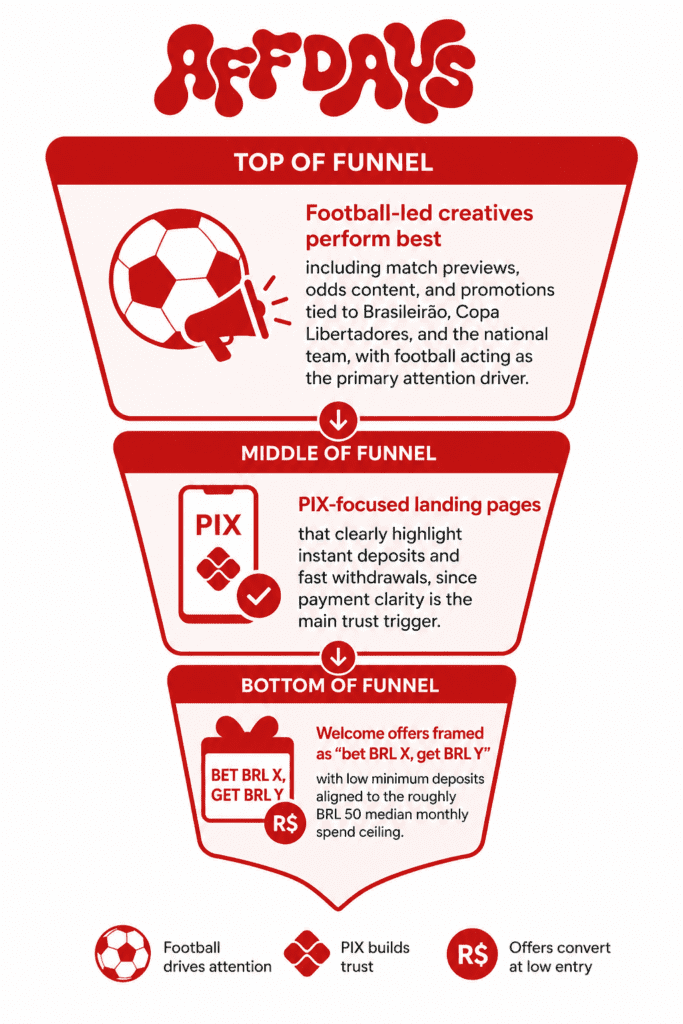
Brazil is the top-priority market and the most well-documented in the region. Affiliates should first verify that their chosen betting affiliate program accepts Brazilian traffic and works with a locally compliant operator. Football is the main entry point across all demographics, not only young male users. The funnel works best when structured as follows:
- Top of funnel: football-led creatives perform best, including match previews, odds content, and promotions tied to Brasileirão, Copa Libertadores, and the national team, with football acting as the primary attention driver;
- Middle of funnel: PIX-focused landing pages that clearly highlight instant deposits and fast withdrawals, since payment clarity is the main trust trigger;
- Bottom of funnel: welcome offers with low minimum deposits, clearly displayed in BRL and supported by familiar PIX deposit and withdrawal flows.
Casino and crash games also perform in Brazil, but they work best as a secondary layer or after a user has already deposited through sports flows. Relevant casino affiliate programs should support Brazilian traffic, BRL payments, Portuguese localization, and the intended acquisition source. A live casino with Portuguese-speaking dealers is a strong retention driver.
Q1 2026 data from Blask shows fast growth in the regulated market, but also increasing competition. Differentiation now depends less on bonus intensity and more on trusted local payments and culturally relevant creative.
Before scaling paid traffic, confirm that the operator’s landing pages and creative pack comply with the latest SPA advertising requirements, not only that the brand appears on the authorized-operator list.
Colombia: Compliance as the Creative Hook
Colombia’s regulated market has trained users to look for visible compliance signals. This is not a barrier, it is a conversion advantage.
Campaigns that lead with “Licensed in Colombia by Coljuegos” often outperform bonus-led messaging because they remove uncertainty before the user reaches the landing page.
- Top hooks: compliance-led messaging such as “Licensed in Colombia by Coljuegos,” which directly addresses trust concerns and reduces hesitation early in the funnel;
- Sports context: football remains the primary entry point, while cycling has strong national relevance, with baseball and basketball performing in specific regions;
- Acquisition channels: influencer-led traffic, streaming integrations, and social-first campaigns often outperform traditional display formats;
- Payments: Daviplata and PSE are the dominant rails, and naming them explicitly in creative improves conversion versus generic payment claims.
This market rewards clarity over volume. Users respond better to signals of legitimacy and familiarity than to aggressive bonus positioning, which makes compliance framing a core part of performance strategy rather than a legal afterthought.
Mexico: Volume Through Vouchers and Mass-Market Spanish
Mexico is the largest Spanish-language iGaming market in the region and also one of the most operationally complex. A key factor is the large unbanked and underbanked population, which relies heavily on cash-in methods to participate in online betting.
- Cash segment: OXXO deposits are critical, and without them a significant portion of the market is unreachable;
- Banked segment: SPEI transfers serve users with direct banking access;
- Localization: Mexican Spanish is required, since generic LatAm Spanish reduces performance; references to clubs like Chivas, América, and Cruz Azul improve engagement;
- Funnel design: OXXO and SPEI users should be separated into different flows because deposit behavior differs significantly;
- Compliance: operator selection must prioritize proven Mexico-specific legal and operational structure, not just broad international coverage.
Mexico rewards operators who adapt to its fragmentation rather than forcing a unified funnel. Payment access and cultural relevance matter more than broad positioning.
Peru: Local Payment Education Pays Off
Peru is shaped by strong adoption of local payment ecosystems. Yape and PLIN are deeply integrated into daily financial behavior, which changes how users evaluate deposits and trust.
- Payments: Yape and PLIN dominate user trust, and explicit mentions like “deposit via Yape” outperform generic payment messaging;
- Sports focus: football is the primary hook, with Liga 1 Peruana acting as the most relevant local reference;
- Trust signals: clear licensing and regulated partnerships reduce friction at the deposit stage;
- User behavior: familiarity with mobile wallets means clarity in instructions has a direct impact on conversion rates.
In Peru, conversion performance is closely tied to how well the payment flow matches existing user habits. The closer the funnel is to real-world behavior, the higher the trust and completion rate.
Chile and Argentina: Premium Positioning and Provincial Complexity
Chile and Argentina require more careful positioning due to income levels, regulation, and payment fragmentation, which directly affect user behavior and conversion paths.
- Chile: highest GDP per capita in the region supports higher deposit potential. Premium sportsbook and casino positioning performs better than mass-market creatives. Webpay is the dominant payment method, while MACH covers prepaid users. Regulatory tightening is ongoing, which increases the importance of compliance clarity;
- Argentina: provincial regulation and currency instability shape user expectations. Fast payouts and clear ARS handling are critical trust drivers. Mercado Pago is the dominant payment method and should always be explicitly referenced in creative;
- Segmentation: Buenos Aires should be treated as a separate high-volume zone when possible, since performance differs significantly from other provinces.
Both markets reward precision over scale. Generic campaigns tend to underperform, while localized payment clarity and premium trust positioning drive stronger results over time.
What Creatives to Use in Promo Campaigns: Examples for LatAm
You must also understand the psychology behind each LatAm player’s decisions. Let’s learn more.
What LatAm Users Respond To
Latin American iGaming users are experienced with advertising and exposed to a high volume of offshore operator messaging. Generic global branding is usually not enough to earn trust or drive action. Conversion tends to depend on how well a creative reflects local reality.
What LatAm users respond to is consistent across most markets. Cultural specificity is one of the strongest signals. Local team colors, real competition names, and recognizable influencers outperform generic football visuals with no country context. Users respond when the creative clearly belongs to their market rather than feeling reused across regions.
Payment method visibility is another core driver.
Seeing PIX in Brazil, OXXO in Mexico, Yape in Peru, or Daviplata in Colombia communicates setup and accessibility instantly. It removes uncertainty before the user even clicks through.
Fast payouts also play a central role in trust building. A common concern across the region is whether withdrawals will actually be processed, especially with unfamiliar operators. Creative that directly addresses payout speed often performs better than bonus-focused messaging, since it speaks to a real friction point.
Language and support visibility matter as well. Clear signals like “24/7 Portuguese support” or “Atención en español” reduce hesitation during registration and improve completion rates. Users want to know they can get help in their language if something goes wrong.
In regulated markets such as Brazil, Colombia, and Peru, licensing and trust badges are not just compliance elements. They act as conversion assets. Users actively check legitimacy, and visible licensing reduces friction at the decision point.
What Does Not Work
What does not work is equally consistent across the region. Generic Spanish or “LatAm-wide” creative tends to underperform because it removes local identity.
Bonus-first messaging without supporting trust signals creates skepticism rather than interest, especially in markets where users are already cautious about offshore operators.
Desktop-first landing pages also underperform due to mobile-heavy traffic. Finally, vague payment language like “multiple payment methods available” is effectively wasted space. Users convert better when specific methods are named directly.
Influencer and Community Channels
Influencer and community channels play a major role in performance. YouTube, Instagram, and TikTok are the primary discovery platforms, with Twitch gaining traction in Brazil and Colombia.
Local sports personalities in Brazil can strongly influence sportsbook conversion, while Colombia shows stronger performance in community-driven recommendation loops where trust is transferred through familiar voices.
Across the region, user-generated content such as win clips and live reactions performs especially well in crash games and live casino formats, where social proof is a key trigger.
Summary
LatAm is not one market. Brazil runs on SPA compliance, Portuguese localization, and PIX. Colombia and Peru reward visible licensing and familiar local payment rails. Mexico requires separate OXXO and SPEI logic. Argentina has to be planned province by province, while Chile remains attractive but legally restricted.
Costa Rica is primarily an industry base, not a standalone player GEO. Guatemala and Nicaragua are secondary Central American tests with limited regulatory or audience transparency. Venezuela shows strong crypto and online-growth signals, but its payment, legal, inflation, and sanctions complexity makes it suitable only for operators with a specialized stack.
Pick the market, verify the operator, confirm the actual deposit and withdrawal flow, and only then build the localized funnel.

Ksenia has extensive hands-on experience in affiliate marketing, having worked as a media buyer and affiliate for several years across multiple verticals. Throughout her career, she managed traffic from a wide range of sources, tested funnels, and collaborated directly with advertisers and networks.
For the past six years, she has also been writing in-depth articles, reviews, and analytical guides about affiliate marketing. Her work has appeared on well-known industry blogs and platforms, where she covers topics such as traffic sources, compliance, creatives, tracking, and campaign optimization.
Today, Ksenia combines practical experience with editorial expertise, contributing as a guest expert to various affiliate marketing projects and helping educate both beginners and experienced affiliates.

Ratmir started his copywriting career back in 2016. He is now editor-in-chief with an MA with Honors in Linguistics.
His primary expertise is in affiliate marketing, EdTech, education, IT, and sports.
Ratmir specializes in content marketing, content management, proofreading, and translation.