Managing multiple accounts is no longer something only large teams deal with. Today, affiliate specialists, media buyers, SaaS teams, agencies, and automation professionals all face the same challenge.
But as infrastructure grows, problems start appearing that are difficult to solve with basic tools alone.
Accounts begin interfering with each other. Sessions become unstable. Security checks appear more often. Repeated logins, regional restrictions, and access issues across different countries slowly turn into part of the daily workflow.
Many people still try to handle this using VPNs or random public IPs. At small scale, that may work temporarily. But in 2026, that approach quickly reaches its limits.
Especially when teams are working across multiple platforms, automating processes, or scaling operations over time.
- Why Traditional Approaches No Longer Work
- How Stable Account Workflows Are Built Today
- Which Proxy Types Are Used for Different Tasks
- Residential Proxies
- ISP Proxies
- Datacenter Proxies
- What Teams Look at When Choosing Proxies
- When This Type of Infrastructure Actually Becomes Necessary
- FAQ
- Which proxies are most commonly used for affiliate workflows?
- When are static IPs necessary?
- Are datacenter proxies suitable for account management?
- What matters more – speed or IP quality?
- Why do teams use multiple proxy types simultaneously?
- Conclusion
Why Traditional Approaches No Longer Work
The main issue with modern multi-account systems is not the number of accounts itself.
The real problem is infrastructure.
Platforms are becoming increasingly sensitive to:
- IP stability
- frequency of IP changes
- session consistency
- connection geography
- traffic distribution
- network reputation
When dozens of accounts operate through unstable IPs or overloaded public networks, it creates technical noise very quickly.
As a result:
- accounts require additional verification
- sessions become less stable
- authorization issues appear more often
- automation becomes unreliable
- teams spend time constantly restoring workflows
This is why more specialists in 2026 are moving away from random setups toward proper IP infrastructure.
How Stable Account Workflows Are Built Today
Most teams no longer rely on a single tool.
Instead, they build a combination of infrastructure components:
- isolated browser profiles
- IP distribution by task
- region-based connections
- controlled IP rotation
- session separation
- traffic management
This is especially important for affiliate teams working simultaneously with ad accounts, trackers, analytics platforms, and payment systems.
For long-term account operations, sticky sessions or static IPs are commonly used. For traffic scaling and request distribution, rotating proxies are often the preferred option.
At this point, proxies are no longer just a “way to change IP addresses.” They have become part of the operational infrastructure that directly affects workflow stability.
Which Proxy Types Are Used for Different Tasks
The choice of proxy usually depends on the specific workflow.

Residential Proxies
Residential IPs are commonly used when natural network behavior and broad GEO coverage are important.
They are often suitable for:
- working with region-based services
- traffic distribution
- request scaling
- localized search monitoring
- automated workflows with large volumes of connections
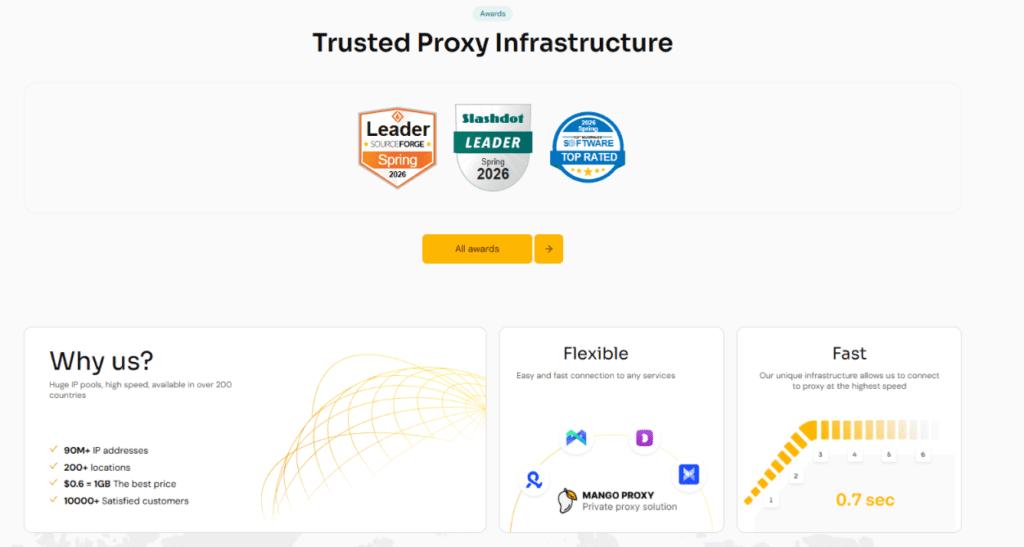
MangoProxy’s residential pool includes more than 90 million IP addresses across 200+ countries. Both rotation and session management are available through the dashboard and API.
ISP Proxies
ISP proxies are typically used for longer and more stable sessions.
They are often chosen for:
- long-term account management
- team workflows
- affiliate infrastructure
- advertising accounts
- services where connection stability matters
In 2026, many teams are shifting toward static ISP proxies because they provide more predictable behavior during long-running sessions.
For example, MangoProxy offers both dynamic ISP proxies with traffic-based pricing and static ISP IPs with monthly billing.
For affiliate-related workflows, the AFFDAYS promo code currently provides an 8% discount on static ISP proxies.
Datacenter Proxies
Datacenter proxies are usually selected for high-load environments where speed and scalability are critical.
Typical use cases include:
- automation
- API requests
- large-scale parsing
- infrastructure tasks
- data monitoring
These proxies are easier to scale and work well for operations involving large volumes of requests.
What Teams Look at When Choosing Proxies
In 2026, price is no longer the main factor.
Teams pay far more attention to:
- IP stability
- infrastructure uptime
- response speed
- pool quality
- sticky session support
- API access
- GEO coverage
- transparent rotation
- HTTP and SOCKS5 support
Another important factor is how easily infrastructure can be managed without manually configuring every connection.
For example, MangoProxy states an average response time below 0.7 seconds and infrastructure uptime above 99.7%. For operational workflows, this is often more important than simply finding the lowest IP price.
When This Type of Infrastructure Actually Becomes Necessary
Proxy infrastructure is not required for everyone.
If someone manages only a few personal accounts without automation or team collaboration, complex setups may be unnecessary.
But once workflows begin involving:
- parallel operations
- distributed teams
- multiple regions
- automation
- persistent sessions
- process scaling
- stable IP infrastructure becomes part of normal operational work rather than an optional tool.
FAQ
Which proxies are most commonly used for affiliate workflows?
ISP and residential proxies are the most common options. ISP proxies are often preferred for long stable sessions, while residential proxies are useful for traffic distribution and multi-region operations.
When are static IPs necessary?
Static IPs are usually important when maintaining a consistent network environment over long periods of time.
Are datacenter proxies suitable for account management?
They can work well for certain workflows, especially where speed and scalability are priorities. The right choice always depends on the specific operational setup.
What matters more – speed or IP quality?
In practice, balance matters most. A fast but unstable IP often creates more problems than a slightly slower but consistent connection.
Why do teams use multiple proxy types simultaneously?
Because different workflows require different infrastructure. One proxy type rarely fits every operational scenario.
Conclusion
In 2026, stable account operations depend less on the number of tools and more on the quality of infrastructure behind them.
Stable IPs, session management, traffic distribution, and predictable connections are gradually becoming a standard part of affiliate, automation, and digital workflows.
That is why more teams are moving away from random solutions toward scalable proxy infrastructure built for long-term operational stability.

Ksenia has extensive hands-on experience in affiliate marketing, having worked as a media buyer and affiliate for several years across multiple verticals. Throughout her career, she managed traffic from a wide range of sources, tested funnels, and collaborated directly with advertisers and networks.
For the past six years, she has also been writing in-depth articles, reviews, and analytical guides about affiliate marketing. Her work has appeared on well-known industry blogs and platforms, where she covers topics such as traffic sources, compliance, creatives, tracking, and campaign optimization.
Today, Ksenia combines practical experience with editorial expertise, contributing as a guest expert to various affiliate marketing projects and helping educate both beginners and experienced affiliates.

Ratmir started his copywriting career back in 2016. He is now editor-in-chief with an MA with Honors in Linguistics.
His primary expertise is in affiliate marketing, EdTech, education, IT, and sports.
Ratmir specializes in content marketing, content management, proofreading, and translation.